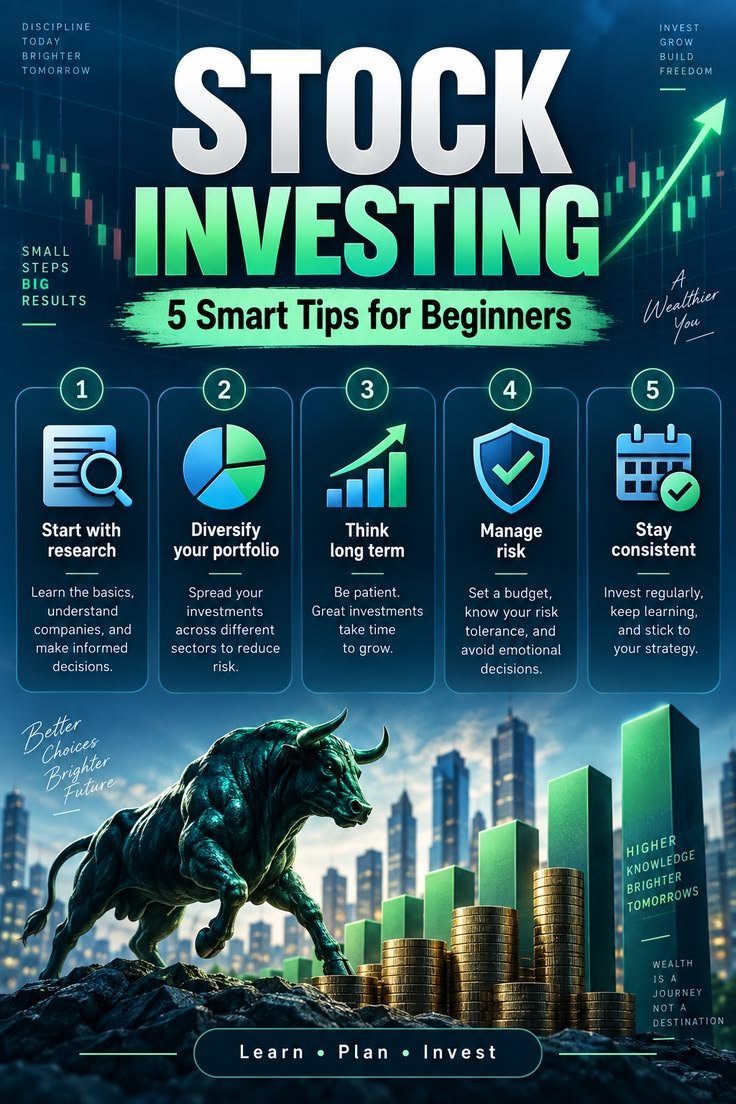
Investing is the process of putting money into assets with the goal of growing your wealth over time. Stocks are one of the most common investments.
A simple way to think about it:
Saving protects money for the near future. Investing aims to grow money for the long future.
What is investing?
When you invest, you buy an asset that you hope will become more valuable or generate income.
Common investments include:
- Stocks/shares — ownership in companies
- Bonds — lending money to governments or companies
- Funds/ETFs — baskets of investments
- Property — physical real estate
- Cash savings — technically an asset, although usually considered saving rather than investing
- Commodities — such as gold
- Alternative assets — e.g. certain private investments
The return from investing can come from:
Capital growth + income − costs/taxes
For example, if you buy shares for £5,000 and later sell them for £6,000, your capital gain is £1,000, before costs and taxes.
What is a stock?
A stock/share represents partial ownership of a company.
Suppose a company has 1 million shares and you own 100 shares.
You own:
100 ÷ 1,000,000 = 0.01%
of the company.
If the company grows successfully, the value of your shares may increase.
Companies issue shares to raise money that can be used for things such as:
- expanding the business
- developing products
- hiring employees
- buying other companies
- reducing debt
- building infrastructure
How do you make money from stocks?
There are two main ways.
A. Capital appreciation
You buy at one price and sell at a higher price.
Example:
You invest £2,000.
The investment rises by 25%.
£2,000 × 1.25 = £2,500
Your gain is £500 before costs/taxes.
But the reverse can happen too. A 25% decline would reduce £2,000 to £1,500.
B. Dividends
Some companies distribute part of their profits to shareholders.
Example:
You own £10,000 of shares and the company pays a 3% annual dividend.
Approximate annual dividend:
£10,000 × 3% = £300
Dividends are not guaranteed and companies can reduce or eliminate them.
. Stock price ≠ company value
A common beginner mistake is thinking:
“This stock is £5, so it is cheaper than a stock costing £500.”
Not necessarily.
The share price alone tells you very little.
You need to consider the company’s market capitalisation:
Share price × number of shares = market capitalisation
For example:
Company A:
- Share price = £5
- Shares = 10 billion
- Market value = £50 billion
Company B:
- Share price = £500
- Shares = 10 million
- Market value = £5 billion
Despite the £500 share price, Company B is actually the smaller company.
Why do stock prices move?
Stock prices change because investors continually reassess what a company may be worth in the future.
Important factors include:
Company performance
- Revenue
- Profit
- Cash flow
- Debt
- Profit margins
Expectations
Markets care not only about what happened, but what investors expect to happen next.
A company can report excellent results and still see its stock fall if investors expected even better results.
Interest rates
Higher interest rates can affect companies and stock valuations because:
- borrowing becomes more expensive
- consumers may spend less
- bonds and cash become relatively more attractive
- future corporate earnings may be valued differently
Economic conditions
Examples:
- recession
- economic growth
- unemployment
- inflation
- consumer spending
Investor sentiment
Fear and optimism can cause prices to move significantly in the short term.
. Risk and return
One of the most important investing principles is:
Higher potential return generally comes with greater risk.
There is no investment that guarantees high returns without risk.
For example:
| Asset | Typical characteristics |
|---|---|
| Cash savings | Lower volatility, lower expected return |
| Government bonds | Generally lower risk than shares, but not risk-free |
| Corporate bonds | More credit risk |
| Broad stock funds | Higher volatility, long-term growth potential |
| Individual stocks | Can be substantially more volatile |
| Speculative assets | Potentially very high losses |
The important distinction is between volatility and permanent loss.
A stock falling 30% temporarily is volatility.
A company going bankrupt can result in a much more permanent loss.
Why diversification matters
Instead of putting all your money into one company, you can spread it across many companies and industries.
For example:
£10,000 in one company
versus
£10,000 spread across hundreds or thousands of companies
If the first company collapses, the first portfolio can suffer an enormous loss.
In a diversified portfolio, the failure of one company has much less impact.
Diversification can occur across:
- companies
- industries
- countries
- currencies
- asset classes
- investment styles
. What is an index?
An index tracks a group of investments.
Examples include:
- S&P 500
- FTSE 100
- FTSE 250
- MSCI World
- Nasdaq-100
An index is not normally something you buy directly. Instead, you can buy a fund designed to track it.
For example, an S&P 500 index fund attempts to provide exposure to the companies represented in the S&P 500.
. What is an ETF?
ETF = Exchange-Traded Fund.
An ETF is a fund that trades on a stock exchange.
Instead of buying 500 individual companies yourself, you could buy one fund that tracks an index containing hundreds of companies.
This can provide:
- diversification
- convenience
- relatively low costs
- easier portfolio management
But ETFs aren’t automatically safe. Their risk depends on what they invest in.
A broad global equity ETF and a highly concentrated leveraged ETF are very different investments.
Individual stocks vs funds
Individual stocks
You choose individual companies.
Potential advantages:
- direct ownership
- possibility of strong returns
- ability to focus on companies you understand
Risks:
- company-specific risk
- greater volatility
- requires research
- difficult to consistently identify future winners
Funds/ETFs
You buy a collection of investments.
Potential advantages:
- diversification
- simplicity
- lower company-specific risk
- easier for beginners
Risks:
- market values can still fall
- management/fund costs
- you don’t control every holding
For many long-term investors, diversified funds are a core building block.