Saving money can feel difficult when your income is limited. After paying for food, housing, transportation, bills, and other necessities, there may seem to be very little left. However, having a low income does not mean you cannot build savings.
The key is to focus on realistic changes rather than trying to save a large amount immediately. Even small amounts can become meaningful when you save consistently.
If you want to save money quickly on a low income, start by identifying unnecessary expenses, setting a specific target, and creating simple habits that you can maintain.
1. Set a Small and Specific Savings Goal
One of the easiest ways to start saving is to choose a clear target.
Instead of saying, “I need to save more,” choose an amount and deadline.
For example:
Save $100 in one month
Save $500 in six months
Build a small emergency fund
Save enough to cover one unexpected bill
A small goal can feel more achievable and help you stay motivated.
Once you reach your first target, you can create another one.
2. Track Every Expense
Before cutting your spending, find out where your money is actually going.
For one month, write down everything you spend, including small purchases.
You might discover that certain expenses are taking more of your income than you realized.
Look at categories such as:
Food
Transportation
Mobile data
Entertainment
Shopping
Subscriptions
Eating out
Household expenses
Tracking your spending does not mean you have to eliminate everything you enjoy. It simply helps you understand where your money is going.
3. Separate Needs From Wants
When money is limited, understanding the difference between needs and wants becomes especially important.
Needs are expenses you generally must pay, such as basic food, housing, utilities, transportation to work, and essential healthcare.
Wants are things you would like to have but could potentially reduce or postpone.
For example, you may not be able to eliminate your rent, but you might be able to reduce restaurant meals, unnecessary shopping, entertainment expenses, or unused subscriptions.
Even small reductions can create money for savings.
4. Save Your Money Before Spending It
A common mistake is waiting until the end of the month to see what is left.
Often, there is nothing left.
Instead, save a small amount as soon as you receive your income.
If you earn $500 and decide to save $25, move the $25 into a separate savings account immediately.
The amount does not have to be large. The goal is to build the habit of paying yourself first.
5. Use a Separate Savings Account
Keeping your savings in the same account you use for everyday spending can make it tempting to spend the money.
A separate savings account can create a psychological barrier between your spending money and your savings.
If possible, choose an account that is safe, accessible when needed, and does not charge unnecessary fees.
You can also give the account a name related to your goal, such as “Emergency Fund” or “House Deposit.”
6. Reduce Food Costs
Food is an area where many people can find opportunities to reduce spending.
Consider:
Planning meals before shopping
Cooking more meals at home
Buying foods you regularly use
Comparing prices
Avoiding unnecessary food waste
Preparing meals in larger quantities
Taking lunch from home when practical
You do not need to completely change your diet.
Even reducing a few unnecessary purchases each week can free up money for savings.
7. Review Your Subscriptions
Take a look at your recurring payments.
You may be paying for services you rarely use.
Check subscriptions for:
Streaming
Music
Fitness
Apps
Cloud storage
Games
Memberships
Canceling one or two unused services may not save a huge amount immediately, but recurring savings can add up over a year.
8. Reduce Impulse Purchases
Impulse spending can quietly damage a tight budget.
A simple strategy is to create a waiting period before buying something that is not essential.
For example, wait 24 hours before making a non-essential purchase.
For more expensive items, consider waiting several days.
This gives you time to decide whether you genuinely need the item or simply wanted it in the moment.
9. Use a Simple Weekly Spending Limit
Monthly budgets can sometimes feel difficult to follow.
A weekly spending limit can make things easier.
For example, after accounting for bills and savings, you might decide that you have a certain amount available for flexible spending each week.
Once you reach that limit, avoid spending more unless the expense is genuinely necessary.
This can make your budget easier to understand and control.
10. Find Small Ways to Increase Your Income
Cutting expenses is only one side of saving money.
If your income is very limited, increasing your income can make a significant difference.
Depending on your skills and circumstances, you might consider:
Freelancing
Selling unused items
Tutoring
Weekend work
Online services
Part-time work
Small local services
Turning a useful skill into a side income
Even an additional amount each month can make saving easier.
However, be cautious about online opportunities that require large upfront payments or promise guaranteed profits.
11. Save Unexpected Money
If you receive money that you were not expecting, consider saving at least part of it.
This could include:
A bonus
A gift
A refund
Extra income
Money from selling unused items
You do not necessarily have to save all of it.
For example, you might decide to save 50% and use the remaining amount for other priorities.
12. Start an Emergency Fund
One of the most useful savings goals is an emergency fund.
An emergency fund can help cover unexpected expenses such as urgent repairs, medical costs, job interruptions, or other necessary bills.
If you have a low income, do not worry about reaching a large target immediately.
Start with a small amount.
Your first goal might be $100, then $250, then $500. Eventually, you can work toward an amount that provides a more substantial financial cushion.
13. Avoid High-Cost Debt When Possible
If you are carrying expensive debt, it can make saving more difficult.
Interest charges can consume money that could otherwise go toward your financial goals.
Consider creating a plan to reduce high-interest debt while also maintaining some emergency savings.
The exact balance will depend on your situation, but ignoring expensive debt completely can make long-term financial progress harder.
14. Try a No-Spend Challenge
A short no-spend challenge can help you identify unnecessary spending.
For example, choose one weekend or one week where you avoid non-essential purchases.
You still pay for necessary expenses, but you avoid things such as unnecessary shopping, restaurant meals, entertainment purchases, or impulse buys.
The goal is not to live without spending forever. It is to become more aware of your spending habits.
15. Increase Your Savings Gradually
Do not feel pressured to save a huge amount immediately.
If you currently save $10 per month, start there.
Once that becomes comfortable, increase it to $15 or $20.
When your income increases, consider directing part of the additional money toward savings.
Gradual increases can be easier to maintain than making an aggressive budget that you cannot realistically follow.
A Simple Example
Imagine someone earns $800 per month.
After essential expenses, they identify $60 that could potentially be redirected toward savings.
They decide to:
Save $30 automatically each month
Reduce unnecessary subscriptions by $10
Cut $10 from impulse purchases
Earn an additional $20 from occasional side work
That creates an additional $70 per month toward their financial goals.
In one year, that could amount to $840 before considering any interest or investment returns.
The important point is that several small changes can work together.
Final Thoughts
Saving money on a low income is not always easy, but it is possible to make progress by focusing on small, consistent actions.
Start by tracking your expenses, separating needs from wants, reducing unnecessary spending, and setting a realistic savings target. Automate your savings when possible and keep your savings separate from everyday spending.
If your income is extremely limited, also look for realistic ways to increase what you earn. You do not need to make dramatic changes overnight.
The goal is to build a financial habit that you can maintain. Even a small amount saved consistently can become a useful financial cushion over time.
What Is Business Finance? — Explain how businesses manage money, including revenue, expenses, cash flow, financing, investment, and financial planning.
Cash Flow Management — Illustrate: Money In → Business Operations → Money Out Highlight the importance of having enough cash available to pay employees, suppliers, bills, and other obligations.
Business Budgeting — Show a simple business budget divided into:
Revenue
Operating costs
Payroll
Marketing
Taxes
Savings/emergency reserves
Investment
Profit vs Cash Flow — Visually explain that profit and cash flow are different financial concepts and that a profitable business can still experience cash-flow problems.
Business Financing — Show common sources:
Business loans
Business credit
Investor funding
Owner’s capital
Retained profits
Financial Statements — Include:
Income statement
Balance sheet
Cash-flow statement
Key Business Metrics — Display:
Revenue
Gross profit
Net profit
Profit margin
Cash flow
Debt
Working capital
Managing Business Debt — Show the concept: Borrow → Invest in Business → Generate Revenue → Repay Debt Include a reminder to understand interest rates, fees, repayment schedules, and total borrowing costs.
Business Growth & Investment — Illustrate money being invested into:
Equipment
Employees
Technology
Marketing
Inventory
Expansion
Financial Planning — Show: Set Goals → Create Budget → Monitor Cash Flow → Control Costs → Build Reserves → Invest for Growth → Review
Key Reminder — “Good business finance means understanding where money comes from, where it goes, how much the business earns, and how much cash is available.”
Include visual elements such as a modern office building, business owner, calculator, financial charts, coins, bank documents, laptop showing financial statements, cash-flow arrows, growth graph, and a business strategy board.
Style: professional business-finance infographic, educational, trustworthy, modern corporate design, minimalist, high-resolution, crisp typography, balanced spacing, visually engaging, no clutter, landscape 16:9 format.
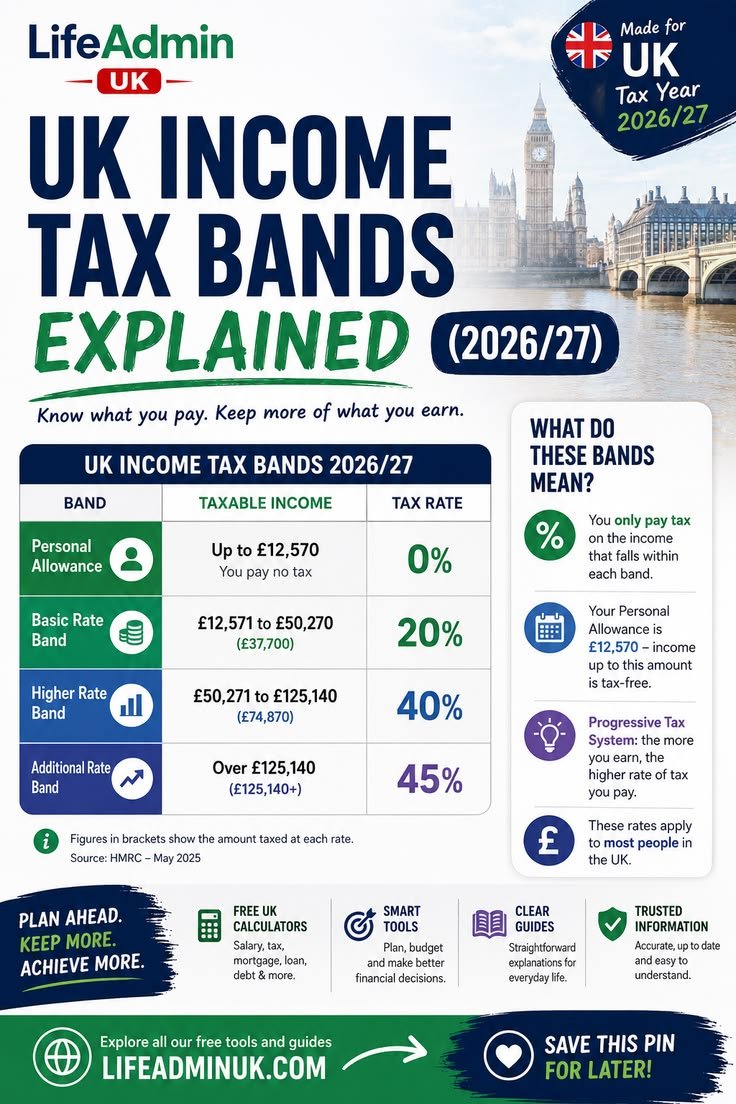
UK Income Tax — Show the basic concept of taxable income, tax bands, and the Personal Allowance. Include a note: “Tax rates and allowances can change.”
National Insurance — Explain that National Insurance contributions can apply to employment and self-employment income, depending on circumstances.
What Is a Pension? — Show how regular contributions can help build retirement savings over time.
Personal Pension / SIPP — Explain that a personal pension can allow individuals to invest for retirement while receiving applicable pension tax benefits.
What Is an ISA? — Explain that an Individual Savings Account can provide tax-efficient saving or investing within applicable annual ISA rules.
Types of ISAs — Visually show:
Cash ISA
Stocks & Shares ISA
Lifetime ISA
Innovative Finance ISA
ISA vs Pension — Create a simple side-by-side comparison covering:
Main purpose
Access to money
Tax treatment
Typical use
Investment options
Planning for Retirement — Show a timeline: Start Saving → Regular Contributions → Investment Growth → Retirement
Tax-Efficient Financial Planning — Show a simple flow: Income → Understand Taxes → Use Allowances → Save/Invest → Build Retirement Wealth
Important Reminder — “UK tax rules, allowances, pension rules and ISA limits can change. Check current HMRC and government guidance before making financial decisions.”
Include visual elements such as the UK flag in a subtle professional style, pound sterling (£) symbols, tax documents, calculator, pension pot, retirement calendar, ISA investment account, savings jar, coins, and a long-term growth chart.
Style: professional UK personal-finance infographic, educational, trustworthy, modern banking and investment design, minimalist, high-resolution, crisp typography, balanced spacing, visually engaging, no clutter, landscape 16:9 format.
What Is a Bank? — Explain that banks provide services such as deposits, payments, savings accounts, lending, and money transfers.
Bank Accounts — Visually show:
Current/checking account
Savings account
Fixed/term deposit account
How Loans Work — Show the basic process: Borrow Money → Pay Interest → Make Regular Payments → Repay the Loan
Types of Loans — Include:
Personal loans
Auto/car loans
Student/education loans
Business loans
Home loans/mortgages
Understanding Interest Rates — Clearly illustrate: Principal + Interest + Fees = Total Cost of Borrowing
What Is a Mortgage? — Show a house, mortgage application, lender, down payment/deposit, monthly payment, and home ownership.
Mortgage Payment Breakdown — Visually explain:
Principal
Interest
Property taxes/fees where applicable
Insurance where applicable
Fixed vs. Variable Interest Rates — Use a simple side-by-side comparison showing: Fixed Rate: payment/rate is generally more predictable. Variable Rate: rate can change according to the loan terms and market conditions.
Credit & Loan Approval — Show factors lenders may consider:
Income
Credit history
Existing debt
Employment
Deposit/down payment
Ability to repay
Smart Borrowing Tips — Include:
Compare interest rates and total borrowing costs
Understand all fees
Borrow only what you can comfortably repay
Read the loan agreement
Keep emergency savings
Avoid unnecessary high-cost debt
Key Reminder — “A loan is borrowed money that must be repaid. Always understand the interest, fees, repayment schedule, and total cost before borrowing.”
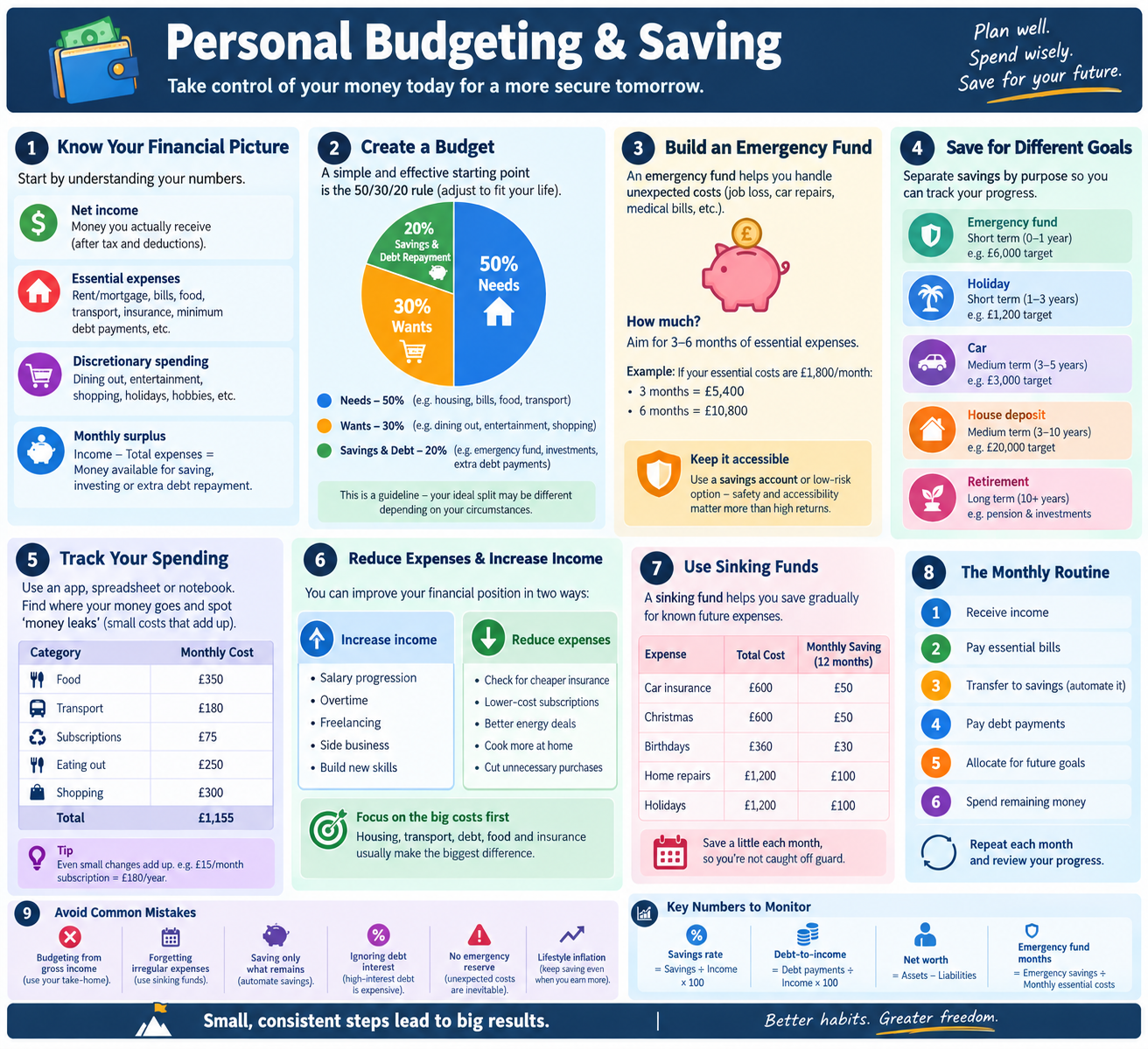
Personal budgeting is the process of deciding where your money should go before you spend it. Saving is the process of deliberately keeping part of your income for future needs and goals.
The overall system is:
Earn → Budget → Spend → Save → Protect → Invest
1. Start with your financial picture
Before making a budget, calculate four numbers:
Monthly net income
The money that actually reaches your account after tax and other deductions.
Include
Salary
Self-employment income
Benefits, where applicable
Regular freelance income
Other reliable income
Don’t rely on uncertain income when planning essential expenses.
Monthly essential expenses
Examples:
Rent/mortgage
Council tax
Utilities
Food
Transport
Insurance
Minimum debt payments
Essential childcare
Monthly discretionary spending
Examples:
Restaurants
Entertainment
Shopping
Holidays
Hobbies
Subscriptions
Monthly saving/debt reduction
This is what you’re deliberately allocating toward your future.
A basic calculation is:
If income is £3,000 and expenses are £2,400:
You have £600 available for saving, investing, additional debt repayment, or other goals.
2. Build a simple budget
A useful starting framework is the 50/30/20 rule:
50% → needs
30% → wants
20% → saving/debt repayment
But treat this as a framework, not a law.
Someone living in an expensive area might need considerably more than 50% for housing. Someone aggressively paying off debt might allocate much more than 20% toward financial goals.
The best budget is one that reflects your actual circumstances.
3. Use three categories
For simplicity, divide spending into:
Needs
Things you genuinely need.
Wants
Things that improve your lifestyle but aren’t essential.
Future you
Money allocated to:
Emergency savings
Debt repayment
Pension
Investments
Major future purchases
This third category is important because saving shouldn’t be treated as merely “whatever happens to be left.”
Pay yourself first.
4. Automate saving
One of the easiest ways to save consistently is automation
For example:
Salary arrives → automatic transfer → savings account
rather than:
Salary arrives → spend → save whatever remains
Suppose you receive £2,500 per month.
You could automatically transfer £300 to savings shortly after payday.
Over 12 months:
That’s £3,600 saved without requiring a decision every month.
5. Create an emergency fund
An emergency fund is money specifically reserved for unexpected financial problems.
Examples:
Sure — what area of finance are you interested in?
💰 Personal budgeting & saving
📈 Investing & stocks
🏦 Banking, loans & mortgages
💷 UK taxes, pensions & ISAs
🧾 Business finance
📊 Financial markets & economics
₿ Crypto
🎓 Learn finance from the basics
Tell me what you’re trying to figure out, and I’ll walk you through it.
full detail on this topic
Absolutely. Finance is the study and practice of how money is earned, managed, invested, borrowed, and allocated over time.
Here is a comprehensive roadmap of the subject, with a UK perspective where relevant.
1. The three major areas of finance
A. Personal finance
How an individual or household manages money.
Key areas:
Income and expenses
Budgeting
Saving
Emergency funds
Debt and credit
Insurance
Mortgages
Pensions
ISAs
Investing
Tax planning
Estate/inheritance planning
B. Corporate finance
How businesses manage money and make financial decisions.
Key areas:
Raising capital
Business valuation
Debt vs equity
Capital structure
Cash-flow management
Investment decisions
Mergers and acquisitions
Dividends
Working capital
Financial reporting
C. Public finance
How governments raise and spend money.
Key areas:
Taxation
Government spending
Public debt
Budget deficits/surpluses
Monetary and fiscal policy
Social security
Public investment
2. The most important concept: cash flow
A fundamental principle of finance is:
Money coming in − money going out = cash flow
For an individual:
Salary + other income − living costs − debt payments − taxes = available cash
For a company:
Revenue − operating costs − taxes − interest − capital expenditure = cash available
Cash flow matters because someone can appear wealthy on paper but still have insufficient cash to pay their bills.
3. Income
Income is money received.
Examples include:
Salary
Freelance income
Business profits
Interest
Dividends
Rental income
Capital gains
Pension income
A useful distinction is gross vs net income.
Gross income = income before deductions.
Net income = what remains after taxes and other deductions.
For example, if someone earns £50,000 gross, they don’t necessarily have £50,000 available to spend.
4. Expenses
Expenses are money you spend.
Fixed expenses
Generally don’t change much each month:
Rent
Mortgage
Insurance
Subscription contracts
Loan payments
Variable expenses
Can change:
Food
Electricity
Entertainment
Travel
Clothing
Needs vs wants
A useful budgeting framework is distinguishing essential spending from discretionary spending.
For example:
Category
Example
Essential
Housing
Essential
Food
Essential
Utilities
Financial
Debt repayment
Financial
Pension
Discretionary
Restaurants
Discretionary
Entertainment
Discretionary
Holidays
5. Budgeting
A budget is a plan for allocating your income.
A simple framework is:
Income → necessities → financial goals → discretionary spending
Suppose someone receives £3,000 per month after tax.
They might allocate:
£1,200 housing
£500 food/utilities
£300 transport
£300 debt repayment
£400 saving/investing
£300 discretionary spending
The exact percentages aren’t universal. The important principle is that spending should be deliberately allocated rather than simply consuming whatever remains.
6. Saving
Saving means putting money aside rather than spending it.
Different savings have different purposes.
Emergency savings
Designed for unexpected expenses such as:
Job loss
Major repairs
Unexpected bills
Emergency travel
Emergency money generally needs to be safe and accessible, rather than exposed to significant investment volatility.
Short-term savings
Examples:
Holiday
Car
House deposit
Education
Long-term savings
Examples:
Retirement
Long-term wealth
Financial independence
The time horizon affects where money should potentially be held.
7. Interest
Interest is the cost of borrowing money or the return earned from lending/saving money.
If you deposit £10,000 at 5% annual interest:
£10,000 × 5% = £500
So, ignoring tax and assuming annual compounding, you’d have approximately:
£10,500 after one year.
8. Compound interest
Compound interest is one of the most important concepts in finance.
Instead of earning returns only on your original money, you can earn returns on previous returns.
The basic formula is:
Where:
FV = future value
PV = present value
r = rate of return
n = number of periods
For example, £10,000 growing at 7% annually for 20 years:
The original £10,000 has become almost £38,700 without adding additional money.
This is why time can be extremely important in investing.
9. Inflation
Inflation means prices generally increase over time.
If inflation is 3%, something costing £100 today could cost roughly £103 next year, assuming that item rises at the overall inflation rate.
This creates an important finance principle:
A pound today generally has greater purchasing power than a pound received many years from now.
Therefore, simply keeping all your money in cash indefinitely may not preserve its purchasing power.
10. Real vs nominal returns
Suppose an investment earns:
8% nominal return
but inflation is:
3%
The approximate real return is:
8% − 3% = 5%
The exact calculation is:
So:
Real returns matter because purchasing power—not simply the number of pounds—is what ultimately matters.
11. Debt
Debt means borrowing money that must generally be repaid.
Examples:
Credit cards
Personal loans
Car finance
Student loans
Mortgages
Business loans
Debt isn’t automatically good or bad.
The important questions include:
How much is borrowed?
What is the interest rate?
How long is the repayment period?
Is the borrowing secured?
What happens if payments are missed?
What opportunity is the borrowing financing?
12. Good debt vs expensive debt
People often use the terms “good debt” and “bad debt,” but the distinction isn’t absolute.
For example, borrowing to purchase an asset or finance education may potentially produce long-term benefits.
High-cost consumer debt can be particularly damaging because interest can compound against you.
If a £5,000 balance is charged at a very high interest rate and only minimum payments are made, repayment can become extremely expensive.
This leads to an important principle:
Compounding works for you when you’re earning returns and against you when you’re paying expensive debt.
13. Credit scores
Credit scores help lenders assess borrowing risk.
Factors can include:
Payment history
Existing borrowing
Credit utilisation
Length of credit history
Applications for credit
Electoral/register information and other data, depending on jurisdiction/provider
In the UK, different credit-reference agencies can produce different scores because lenders may use different information and scoring systems.
The underlying principle is more important than obsessing over a particular numerical score:
Demonstrating reliable repayment behaviour generally helps when seeking credit.
14. Investing
Investing means committing money to assets with the expectation of generating a return.
Major asset classes include:
Shares/equities
You own part of a company.
Potential returns:
Capital appreciation
Dividends
Risks:
Share prices can fall
Companies can fail
Returns aren’t guaranteed
Bonds
You effectively lend money to a government or company.
Potential return:
Interest/coupon payments
Potential change in bond value
Risks:
Default
Interest-rate changes
Inflation
Property
Potential returns:
Rental income
Capital appreciation
Risks:
Property prices falling
Vacancies
Maintenance
Transaction costs
Interest-rate changes
Cash
Examples:
Bank deposits
Savings accounts
Cash equivalents
Generally lower volatility, but inflation can reduce purchasing power.
15. Risk and return
A central finance principle is the relationship between risk and expected return.
Generally, investors demand compensation for taking additional risk.
But:
Higher risk does NOT guarantee higher returns.
An investment can have high potential returns and also a significant possibility of losing money.
16. Diversification
Diversification means spreading investments across different assets.
Instead of:
£100,000 → one company
you might have exposure to:
thousands of companies across multiple countries and industries
The purpose is to reduce the damage caused by any single investment performing badly.
A classic principle is:
Don’t put all your eggs in one basket.
17. Stocks and shares
A share represents ownership in a company.
If a company has 1 million shares and you own 10,000:
You own 1% of the company, subject to the particular share structure and rights.
Shareholders can potentially benefit through:
Capital gains
Dividends
But share prices can also fall substantially.
18. Stock markets
Stock exchanges provide mechanisms for buying and selling securities.
Examples include:
London Stock Exchange
New York Stock Exchange
Nasdaq
Major market indices include:
FTSE 100
S&P 500
Nasdaq Composite
Dow Jones Industrial Average
An index tracks a group of securities according to a defined methodology.
19. Index funds
Instead of trying to select individual companies, an investor can buy a fund designed to track an index.
For example, an index fund might attempt to track a broad market index.
Advantages can include:
Diversification
Simplicity
Often relatively low costs
Reduced dependence on individual stock selection
But index investing still involves market risk.
20. ETFs
An Exchange-Traded Fund (ETF) is a fund whose shares trade on an exchange.
An ETF can provide exposure to:
Stocks
Bonds
Commodities
Specific sectors
Countries
Broad markets
For example, one ETF could contain hundreds or thousands of companies.
21. Mutual funds
A mutual fund pools money from many investors and invests according to its stated strategy.
The fund might be:
Actively managed
Passively managed
Active management involves a manager making investment decisions.
Passive management generally attempts to track an index or benchmark.
22. Dividends
A dividend is a distribution of company profits or capital to shareholders, subject to the company’s circumstances and applicable rules.
For example:
You own £20,000 of shares.
If the portfolio produces a 3% dividend yield:
That doesn’t mean the investment has guaranteed £600 of total profit—the share price can rise or fall.
23. Capital gains
A capital gain occurs when an asset is sold for more than its acquisition cost, subject to relevant adjustments.
Example:
Buy shares for:
£10,000
Sell for:
£14,000
Gross gain:
£4,000
Tax treatment depends on the jurisdiction, asset, account type, allowances and other circumstances.
24. Risk management
Finance isn’t only about making money.
It is also about preventing catastrophic losses.
Important techniques include:
Diversification
Insurance
Emergency savings
Appropriate debt levels
Position sizing
Asset allocation
Hedging
Maintaining liquidity
25. Insurance
Insurance transfers certain financial risks to an insurer in exchange for premiums.
Types include:
Life insurance
Home insurance
Car insurance
Health insurance
Income protection
Business insurance
Travel insurance
The basic concept is:
Pay a relatively predictable cost to protect against a potentially very large loss.
26. Pensions
A pension is designed primarily to provide income or assets for retirement.
In the UK, important concepts include:
Workplace pensions
Auto-enrolment
Personal pensions
SIPP
Pension tax relief
Employer contributions
Investment growth
Pension access rules
Pensions are important because retirement may last decades, requiring substantial accumulated assets.
27. ISAs
An ISA is a UK tax-advantaged savings/investment account.
Types include:
Cash ISA
Stocks & Shares ISA
Lifetime ISA
Innovative Finance ISA
The tax treatment and annual allowances are subject to current UK rules, which can change.
Good financial planning considers after-tax returns, not simply headline returns.
29. Financial statements
For businesses, three financial statements are especially important.
Income statement
Shows financial performance over a period.
Basic idea:
Revenue − expenses = profit
Balance sheet
Shows financial position at a point in time.
Basic accounting equation:
Cash-flow statement
Shows movements of cash.
It typically separates:
Operating activities
Investing activities
Financing activities
30. Business valuation
Investors and financial professionals try to determine what a company may be worth.
Common approaches include:
Price-to-earnings ratio
Price-to-sales
EV/EBITDA
Enterprise value compared with earnings before interest, taxes, depreciation and amortisation.
Discounted cash flow
DCF estimates the present value of future cash flows.
31. Time value of money
One of the foundations of finance is:
£1 today is not financially equivalent to £1 received in the future.
Why?
Because today’s £1 can potentially be invested and earn a return.
The present value of future money can be calculated using:
This concept underlies:
Bond valuation
Company valuation
Pension calculations
Investment analysis
Loan pricing
32. Bonds
A bond represents debt.
Suppose you purchase a £1,000 bond with a 5% annual coupon.
You may receive:
£50 per year
subject to the bond’s terms.
At maturity, the principal is generally repaid, assuming no default and subject to the terms.
Important relationship
Bond prices and market interest rates generally move in opposite directions.
When market rates rise, existing fixed-rate bonds can become less attractive, so their market prices generally fall.
33. Interest rates
Interest rates influence almost every area of finance.
Higher rates can affect:
Mortgages
Loans
Savings
Bonds
Business investment
Housing
Consumer spending
Currency markets
Stock valuations
Central banks use interest rates as an important monetary-policy tool.
In the UK, the Bank of England plays a central role in monetary policy.
34. Central banking
Central banks generally have responsibilities such as:
Monetary policy
Interest-rate decisions
Financial stability
Currency-related functions
Banking-system operations
Central-bank policy can have significant effects on financial markets.
35. Foreign exchange
Foreign exchange, or FX, involves trading currencies.
Examples:
GBP/USD
EUR/GBP
USD/JPY
If:
£1 = $1.30
then £1,000 would correspond to approximately:
$1,300
before transaction costs and exchange-rate movements.
Currency movements affect:
International investing
Imports
Exports
Travel
Multinational companies
Inflation
36. Derivatives
Derivatives are financial contracts whose value depends on an underlying asset or variable.
Examples:
Futures
Options
Swaps
Forwards
They can be used for:
Hedging
Risk management
Speculation
Price discovery
They can also be complex and involve substantial risk.
37. Options
An option gives the holder a contractual right—but generally not an obligation—to buy or sell an underlying asset under specified terms.
Two fundamental types:
Call option → right to buy
Put option → right to sell
Options involve concepts such as:
Strike price
Expiration date
Premium
Volatility
Intrinsic value
Time value
Some option strategies can expose investors to losses that are much larger than the initial amount they paid, particularly when selling options or using leverage.
38. Leverage
Leverage means using borrowed money or financial instruments to increase exposure.
Example:
You have £10,000.
You borrow £40,000.
You now control:
£50,000
of assets.
If those assets rise 10%, the gain is:
£5,000
on £10,000 of your original capital.
But if they fall 10%, you lose:
£5,000
before financing costs.
So leverage magnifies both gains and losses.
39. Liquidity
Liquidity describes how easily an asset can be converted into cash without significantly affecting its price.
Generally:
Cash → highly liquid
Large publicly traded shares → generally highly liquid
Property → generally less liquid
Liquidity matters because emergencies require accessible money.
40. Net worth
A simple measure of personal wealth is:
Example:
Assets:
£250,000 house
£30,000 investments
£10,000 cash
Total:
£290,000
Liabilities:
£180,000 mortgage
£5,000 other debt
Total:
£185,000
Net worth:
41. Asset allocation
Asset allocation determines how your investments are distributed among asset classes.
For example, someone might hold exposure to:
Equities
Bonds
Cash
Property
The appropriate allocation depends on factors such as:
Time horizon
Risk tolerance
Financial objectives
Need for liquidity
Existing assets
Income stability
There isn’t one universally correct allocation for everyone.
42. Financial goals
Finance becomes much easier when goals are defined.
Examples:
Short term
0–3 years:
Emergency fund
Holiday
Car
Upcoming purchase
Medium term
3–10 years:
House deposit
Education
Business
Major life event
Long term
10+ years:
Retirement
Financial independence
Long-term wealth
Different goals require different strategies.
43. Financial independence
Financial independence generally means having sufficient assets or income-producing resources that employment is no longer necessary to meet one’s desired spending needs.
A simplified conceptual formula is:
The appropriate withdrawal rate is uncertain and depends on investment returns, inflation, taxes, lifespan, spending flexibility and other factors.
44. The psychology of finance
Finance isn’t purely mathematical.
Human behaviour strongly affects financial outcomes.
Common behavioural biases include:
Loss aversion
People often feel losses more strongly than equivalent gains.
Herd behaviour
People may follow what others are doing.
Overconfidence
Investors may overestimate their ability to predict markets.
Recency bias
Recent events can disproportionately influence expectations.
Confirmation bias
People may seek information supporting beliefs they already hold.
Understanding these biases is an important part of investing.
If you tell me whether you’re learning finance for personal wealth, investing/trading, university, an MBA, or a career in banking/finance, I can turn this into a structured beginner-to-advanced course with lessons, formulas, worked examples, exercises, and quizzes.
Personal budgeting & saving
Personal Budgeting & Saving — Complete Guide
Personal budgeting is the process of deciding where your money should go before you spend it. Saving is the process of deliberately keeping part of your income for future needs and goals.
The overall system is:
Earn → Budget → Spend → Save → Protect → Invest
1. Start with your financial picture
Before making a budget, calculate four numbers:
Monthly net income
The money that actually reaches your account after tax and other deductions.
Include:
Salary
Self-employment income
Benefits, where applicable
Regular freelance income
Other reliable income
Don’t rely on uncertain income when planning essential expenses.
Monthly essential expenses
Examples:
Rent/mortgage
Council tax
Utilities
Food
Transport
Insurance
Minimum debt payments
Essential childcare
Monthly discretionary spending
Examples:
Restaurants
Entertainment
Shopping
Holidays
Hobbies
Subscriptions
Monthly saving/debt reduction
This is what you’re deliberately allocating toward your future.
A basic calculation is:
If income is £3,000 and expenses are £2,400:
You have £600 available for saving, investing, additional debt repayment, or other goals.
2. Build a simple budget
A useful starting framework is the 50/30/20 rule:
50% → needs
30% → wants
20% → saving/debt repayment
But treat this as a framework, not a law.
Someone living in an expensive area might need considerably more than 50% for housing. Someone aggressively paying off debt might allocate much more than 20% toward financial goals.
The best budget is one that reflects your actual circumstances.
3. Use three categories
For simplicity, divide spending into:
Needs
Things you genuinely need.
Wants
Things that improve your lifestyle but aren’t essential.
Future you
Money allocated to:
Emergency savings
Debt repayment
Pension
Investments
Major future purchases
This third category is important because saving shouldn’t be treated as merely “whatever happens to be left.”
Pay yourself first.
4. Automate saving
One of the easiest ways to save consistently is automation.
For example:
Salary arrives → automatic transfer → savings account
rather than:
Salary arrives → spend → save whatever remains
Suppose you receive £2,500 per month.
You could automatically transfer £300 to savings shortly after payday.
Over 12 months:
That’s £3,600 saved without requiring a decision every month.
5. Create an emergency fund
An emergency fund is money specifically reserved for unexpected financial problems.
Examples:
Sure — what area of finance are you interested in?
💰 Personal budgeting & saving
📈 Investing & stocks
🏦 Banking, loans & mortgages
💷 UK taxes, pensions & ISAs
🧾 Business finance
📊 Financial markets & economics
₿ Crypto
🎓 Learn finance from the basics
Tell me what you’re trying to figure out, and I’ll walk you through it.
full detail on this topic
Absolutely. Finance is the study and practice of how money is earned, managed, invested, borrowed, and allocated over time.
Here is a comprehensive roadmap of the subject, with a UK perspective where relevant.
1. The three major areas of finance
A. Personal finance
How an individual or household manages money.
Key areas:
Income and expenses
Budgeting
Saving
Emergency funds
Debt and credit
Insurance
Mortgages
Pensions
ISAs
Investing
Tax planning
Estate/inheritance planning
B. Corporate finance
How businesses manage money and make financial decisions.
Key areas:
Raising capital
Business valuation
Debt vs equity
Capital structure
Cash-flow management
Investment decisions
Mergers and acquisitions
Dividends
Working capital
Financial reporting
C. Public finance
How governments raise and spend money.
Key areas:
Taxation
Government spending
Public debt
Budget deficits/surpluses
Monetary and fiscal policy
Social security
Public investment
2. The most important concept: cash flow
A fundamental principle of finance is:
Money coming in − money going out = cash flow
For an individual:
Salary + other income − living costs − debt payments − taxes = available cash
For a company:
Revenue − operating costs − taxes − interest − capital expenditure = cash available
Cash flow matters because someone can appear wealthy on paper but still have insufficient cash to pay their bills.
3. Income
Income is money received.
Examples include:
Salary
Freelance income
Business profits
Interest
Dividends
Rental income
Capital gains
Pension income
A useful distinction is gross vs net income.
Gross income = income before deductions.
Net income = what remains after taxes and other deductions.
For example, if someone earns £50,000 gross, they don’t necessarily have £50,000 available to spend.
4. Expenses
Expenses are money you spend.
Fixed expenses
Generally don’t change much each month:
Rent
Mortgage
Insurance
Subscription contracts
Loan payments
Variable expenses
Can change:
Food
Electricity
Entertainment
Travel
Clothing
Needs vs wants
A useful budgeting framework is distinguishing essential spending from discretionary spending.
For example:
Category
Example
Essential
Housing
Essential
Food
Essential
Utilities
Financial
Debt repayment
Financial
Pension
Discretionary
Restaurants
Discretionary
Entertainment
Discretionary
Holidays
5. Budgeting
A budget is a plan for allocating your income.
A simple framework is:
Income → necessities → financial goals → discretionary spending
Suppose someone receives £3,000 per month after tax.
They might allocate:
£1,200 housing
£500 food/utilities
£300 transport
£300 debt repayment
£400 saving/investing
£300 discretionary spending
The exact percentages aren’t universal. The important principle is that spending should be deliberately allocated rather than simply consuming whatever remains.
6. Saving
Saving means putting money aside rather than spending it.
Different savings have different purposes.
Emergency savings
Designed for unexpected expenses such as:
Job loss
Major repairs
Unexpected bills
Emergency travel
Emergency money generally needs to be safe and accessible, rather than exposed to significant investment volatility.
Short-term savings
Examples:
Holiday
Car
House deposit
Education
Long-term savings
Examples:
Retirement
Long-term wealth
Financial independence
The time horizon affects where money should potentially be held.
7. Interest
Interest is the cost of borrowing money or the return earned from lending/saving money.
If you deposit £10,000 at 5% annual interest:
£10,000 × 5% = £500
So, ignoring tax and assuming annual compounding, you’d have approximately:
£10,500 after one year.
8. Compound interest
Compound interest is one of the most important concepts in finance.
Instead of earning returns only on your original money, you can earn returns on previous returns.
The basic formula is:
Where:
FV = future value
PV = present value
r = rate of return
n = number of periods
For example, £10,000 growing at 7% annually for 20 years:
The original £10,000 has become almost £38,700 without adding additional money.
This is why time can be extremely important in investing.
9. Inflation
Inflation means prices generally increase over time.
If inflation is 3%, something costing £100 today could cost roughly £103 next year, assuming that item rises at the overall inflation rate.
This creates an important finance principle:
A pound today generally has greater purchasing power than a pound received many years from now.
Therefore, simply keeping all your money in cash indefinitely may not preserve its purchasing power.
10. Real vs nominal returns
Suppose an investment earns:
8% nominal return
but inflation is:
3%
The approximate real return is:
8% − 3% = 5%
The exact calculation is:
So:
Real returns matter because purchasing power—not simply the number of pounds—is what ultimately matters.
11. Debt
Debt means borrowing money that must generally be repaid.
Examples:
Credit cards
Personal loans
Car finance
Student loans
Mortgages
Business loans
Debt isn’t automatically good or bad.
The important questions include:
How much is borrowed?
What is the interest rate?
How long is the repayment period?
Is the borrowing secured?
What happens if payments are missed?
What opportunity is the borrowing financing?
12. Good debt vs expensive debt
People often use the terms “good debt” and “bad debt,” but the distinction isn’t absolute.
For example, borrowing to purchase an asset or finance education may potentially produce long-term benefits.
High-cost consumer debt can be particularly damaging because interest can compound against you.
If a £5,000 balance is charged at a very high interest rate and only minimum payments are made, repayment can become extremely expensive.
This leads to an important principle:
Compounding works for you when you’re earning returns and against you when you’re paying expensive debt.
13. Credit scores
Credit scores help lenders assess borrowing risk.
Factors can include:
Payment history
Existing borrowing
Credit utilisation
Length of credit history
Applications for credit
Electoral/register information and other data, depending on jurisdiction/provider
In the UK, different credit-reference agencies can produce different scores because lenders may use different information and scoring systems.
The underlying principle is more important than obsessing over a particular numerical score:
Demonstrating reliable repayment behaviour generally helps when seeking credit.
14. Investing
Investing means committing money to assets with the expectation of generating a return.
Major asset classes include:
Shares/equities
You own part of a company.
Potential returns:
Capital appreciation
Dividends
Risks:
Share prices can fall
Companies can fail
Returns aren’t guaranteed
Bonds
You effectively lend money to a government or company.
Potential return:
Interest/coupon payments
Potential change in bond value
Risks:
Default
Interest-rate changes
Inflation
Property
Potential returns:
Rental income
Capital appreciation
Risks:
Property prices falling
Vacancies
Maintenance
Transaction costs
Interest-rate changes
Cash
Examples:
Bank deposits
Savings accounts
Cash equivalents
Generally lower volatility, but inflation can reduce purchasing power.
15. Risk and return
A central finance principle is the relationship between risk and expected return.
Generally, investors demand compensation for taking additional risk.
But:
Higher risk does NOT guarantee higher returns.
An investment can have high potential returns and also a significant possibility of losing money.
16. Diversification
Diversification means spreading investments across different assets.
Instead of:
£100,000 → one company
you might have exposure to:
thousands of companies across multiple countries and industries
The purpose is to reduce the damage caused by any single investment performing badly.
A classic principle is:
Don’t put all your eggs in one basket.
17. Stocks and shares
A share represents ownership in a company.
If a company has 1 million shares and you own 10,000:
You own 1% of the company, subject to the particular share structure and rights.
Shareholders can potentially benefit through:
Capital gains
Dividends
But share prices can also fall substantially.
18. Stock markets
Stock exchanges provide mechanisms for buying and selling securities.
Examples include:
London Stock Exchange
New York Stock Exchange
Nasdaq
Major market indices include:
FTSE 100
S&P 500
Nasdaq Composite
Dow Jones Industrial Average
An index tracks a group of securities according to a defined methodology.
19. Index funds
Instead of trying to select individual companies, an investor can buy a fund designed to track an index.
For example, an index fund might attempt to track a broad market index.
Advantages can include:
Diversification
Simplicity
Often relatively low costs
Reduced dependence on individual stock selection
But index investing still involves market risk.
20. ETFs
An Exchange-Traded Fund (ETF) is a fund whose shares trade on an exchange.
An ETF can provide exposure to:
Stocks
Bonds
Commodities
Specific sectors
Countries
Broad markets
For example, one ETF could contain hundreds or thousands of companies.
21. Mutual funds
A mutual fund pools money from many investors and invests according to its stated strategy.
The fund might be:
Actively managed
Passively managed
Active management involves a manager making investment decisions.
Passive management generally attempts to track an index or benchmark.
22. Dividends
A dividend is a distribution of company profits or capital to shareholders, subject to the company’s circumstances and applicable rules.
For example:
You own £20,000 of shares.
If the portfolio produces a 3% dividend yield:
That doesn’t mean the investment has guaranteed £600 of total profit—the share price can rise or fall.
23. Capital gains
A capital gain occurs when an asset is sold for more than its acquisition cost, subject to relevant adjustments.
Example:
Buy shares for:
£10,000
Sell for:
£14,000
Gross gain:
£4,000
Tax treatment depends on the jurisdiction, asset, account type, allowances and other circumstances.
24. Risk management
Finance isn’t only about making money.
It is also about preventing catastrophic losses.
Important techniques include:
Diversification
Insurance
Emergency savings
Appropriate debt levels
Position sizing
Asset allocation
Hedging
Maintaining liquidity
25. Insurance
Insurance transfers certain financial risks to an insurer in exchange for premiums.
Types include:
Life insurance
Home insurance
Car insurance
Health insurance
Income protection
Business insurance
Travel insurance
The basic concept is:
Pay a relatively predictable cost to protect against a potentially very large loss.
26. Pensions
A pension is designed primarily to provide income or assets for retirement.
In the UK, important concepts include:
Workplace pensions
Auto-enrolment
Personal pensions
SIPP
Pension tax relief
Employer contributions
Investment growth
Pension access rules
Pensions are important because retirement may last decades, requiring substantial accumulated assets.
27. ISAs
An ISA is a UK tax-advantaged savings/investment account.
Types include:
Cash ISA
Stocks & Shares ISA
Lifetime ISA
Innovative Finance ISA
The tax treatment and annual allowances are subject to current UK rules, which can change.
Good financial planning considers after-tax returns, not simply headline returns.
29. Financial statements
For businesses, three financial statements are especially important.
Income statement
Shows financial performance over a period.
Basic idea:
Revenue − expenses = profit
Balance sheet
Shows financial position at a point in time.
Basic accounting equation:
Cash-flow statement
Shows movements of cash.
It typically separates:
Operating activities
Investing activities
Financing activities
30. Business valuation
Investors and financial professionals try to determine what a company may be worth.
Common approaches include:
Price-to-earnings ratio
Price-to-sales
EV/EBITDA
Enterprise value compared with earnings before interest, taxes, depreciation and amortisation.
Discounted cash flow
DCF estimates the present value of future cash flows.
31. Time value of money
One of the foundations of finance is:
£1 today is not financially equivalent to £1 received in the future.
Why?
Because today’s £1 can potentially be invested and earn a return.
The present value of future money can be calculated using:
This concept underlies:
Bond valuation
Company valuation
Pension calculations
Investment analysis
Loan pricing
32. Bonds
A bond represents debt.
Suppose you purchase a £1,000 bond with a 5% annual coupon.
You may receive:
£50 per year
subject to the bond’s terms.
At maturity, the principal is generally repaid, assuming no default and subject to the terms.
Important relationship
Bond prices and market interest rates generally move in opposite directions.
When market rates rise, existing fixed-rate bonds can become less attractive, so their market prices generally fall.
33. Interest rates
Interest rates influence almost every area of finance.
Higher rates can affect:
Mortgages
Loans
Savings
Bonds
Business investment
Housing
Consumer spending
Currency markets
Stock valuations
Central banks use interest rates as an important monetary-policy tool.
In the UK, the Bank of England plays a central role in monetary policy.
34. Central banking
Central banks generally have responsibilities such as:
Monetary policy
Interest-rate decisions
Financial stability
Currency-related functions
Banking-system operations
Central-bank policy can have significant effects on financial markets.
35. Foreign exchange
Foreign exchange, or FX, involves trading currencies.
Examples:
GBP/USD
EUR/GBP
USD/JPY
If:
£1 = $1.30
then £1,000 would correspond to approximately:
$1,300
before transaction costs and exchange-rate movements.
Currency movements affect:
International investing
Imports
Exports
Travel
Multinational companies
Inflation
36. Derivatives
Derivatives are financial contracts whose value depends on an underlying asset or variable.
Examples:
Futures
Options
Swaps
Forwards
They can be used for:
Hedging
Risk management
Speculation
Price discovery
They can also be complex and involve substantial risk.
37. Options
An option gives the holder a contractual right—but generally not an obligation—to buy or sell an underlying asset under specified terms.
Two fundamental types:
Call option → right to buy
Put option → right to sell
Options involve concepts such as:
Strike price
Expiration date
Premium
Volatility
Intrinsic value
Time value
Some option strategies can expose investors to losses that are much larger than the initial amount they paid, particularly when selling options or using leverage.
38. Leverage
Leverage means using borrowed money or financial instruments to increase exposure.
Example:
You have £10,000.
You borrow £40,000.
You now control:
£50,000
of assets.
If those assets rise 10%, the gain is:
£5,000
on £10,000 of your original capital.
But if they fall 10%, you lose:
£5,000
before financing costs.
So leverage magnifies both gains and losses.
39. Liquidity
Liquidity describes how easily an asset can be converted into cash without significantly affecting its price.
Generally:
Cash → highly liquid
Large publicly traded shares → generally highly liquid
Property → generally less liquid
Liquidity matters because emergencies require accessible money.
40. Net worth
A simple measure of personal wealth is:
Example:
Assets:
£250,000 house
£30,000 investments
£10,000 cash
Total:
£290,000
Liabilities:
£180,000 mortgage
£5,000 other debt
Total:
£185,000
Net worth:
41. Asset allocation
Asset allocation determines how your investments are distributed among asset classes.
For example, someone might hold exposure to:
Equities
Bonds
Cash
Property
The appropriate allocation depends on factors such as:
Time horizon
Risk tolerance
Financial objectives
Need for liquidity
Existing assets
Income stability
There isn’t one universally correct allocation for everyone.
42. Financial goals
Finance becomes much easier when goals are defined.
Examples:
Short term
0–3 years:
Emergency fund
Holiday
Car
Upcoming purchase
Medium term
3–10 years:
House deposit
Education
Business
Major life event
Long term
10+ years:
Retirement
Financial independence
Long-term wealth
Different goals require different strategies.
43. Financial independence
Financial independence generally means having sufficient assets or income-producing resources that employment is no longer necessary to meet one’s desired spending needs.
A simplified conceptual formula is:
The appropriate withdrawal rate is uncertain and depends on investment returns, inflation, taxes, lifespan, spending flexibility and other factors.
44. The psychology of finance
Finance isn’t purely mathematical.
Human behaviour strongly affects financial outcomes.
Common behavioural biases include:
Loss aversion
People often feel losses more strongly than equivalent gains.
Herd behaviour
People may follow what others are doing.
Overconfidence
Investors may overestimate their ability to predict markets.
Recency bias
Recent events can disproportionately influence expectations.
Confirmation bias
People may seek information supporting beliefs they already hold.
Understanding these biases is an important part of investing.
If you tell me whether you’re learning finance for personal wealth, investing/trading, university, an MBA, or a career in banking/finance, I can turn this into a structured beginner-to-advanced course with lessons, formulas, worked examples, exercises, and quizzes.
Personal budgeting & saving
Personal Budgeting & Saving — Complete Guide
Personal budgeting is the process of deciding where your money should go before you spend it. Saving is the process of deliberately keeping part of your income for future needs and goals.
The overall system is:
Earn → Budget → Spend → Save → Protect → Invest
1. Start with your financial picture
Before making a budget, calculate four numbers:
Monthly net income
The money that actually reaches your account after tax and other deductions.
Include:
Salary
Self-employment income
Benefits, where applicable
Regular freelance income
Other reliable income
Don’t rely on uncertain income when planning essential expenses.
Monthly essential expenses
Examples:
Rent/mortgage
Council tax
Utilities
Food
Transport
Insurance
Minimum debt payments
Essential childcare
Monthly discretionary spending
Examples:
Restaurants
Entertainment
Shopping
Holidays
Hobbies
Subscriptions
Monthly saving/debt reduction
This is what you’re deliberately allocating toward your future.
A basic calculation is:
If income is £3,000 and expenses are £2,400:
You have £600 available for saving, investing, additional debt repayment, or other goals.
2. Build a simple budget
A useful starting framework is the 50/30/20 rule:
50% → needs
30% → wants
20% → saving/debt repayment
But treat this as a framework, not a law.
Someone living in an expensive area might need considerably more than 50% for housing. Someone aggressively paying off debt might allocate much more than 20% toward financial goals.
The best budget is one that reflects your actual circumstances.
3. Use three categories
For simplicity, divide spending into:
Needs
Things you genuinely need.
Wants
Things that improve your lifestyle but aren’t essential.
Future you
Money allocated to:
Emergency savings
Debt repayment
Pension
Investments
Major future purchases
This third category is important because saving shouldn’t be treated as merely “whatever happens to be left.”
Pay yourself first.
4. Automate saving
One of the easiest ways to save consistently is automation.
For example:
Salary arrives → automatic transfer → savings account
rather than:
Salary arrives → spend → save whatever remains
Suppose you receive £2,500 per month.
You could automatically transfer £300 to savings shortly after payday.
Over 12 months:
That’s £3,600 saved without requiring a decision every month.
5. Create an emergency fund
An emergency fund is money specifically reserved for unexpected financial problems.
The exact calculation is:
So:
Real returns matter because purchasing power—not simply the number of pounds—is what ultimately matters.
11. Debt
Debt means borrowing money that must generally be repaid.
Examples:
Credit cards
Personal loans
Car finance
Student loans
Mortgages
Business loans
Debt isn’t automatically good or bad.
The important questions include:
How much is borrowed?
What is the interest rate?
How long is the repayment period?
Is the borrowing secured?
What happens if payments are missed?
What opportunity is the borrowing financing?
12. Good debt vs expensive debt
People often use the terms “good debt” and “bad debt,” but the distinction isn’t absolute.
For example, borrowing to purchase an asset or finance education may potentially produce long-term benefits.
High-cost consumer debt can be particularly damaging because interest can compound against you.
If a £5,000 balance is charged at a very high interest rate and only minimum payments are made, repayment can become extremely expensive.
This leads to an important principle:
Compounding works for you when you’re earning returns and against you when you’re paying expensive debt.
13. Credit scores
Credit scores help lenders assess borrowing risk.
Factors can include:
Payment history
Existing borrowing
Credit utilisation
Length of credit history
Applications for credit
Electoral/register information and other data, depending on jurisdiction/provider
In the UK, different credit-reference agencies can produce different scores because lenders may use different information and scoring systems.
The underlying principle is more important than obsessing over a particular numerical score:
Demonstrating reliable repayment behaviour generally helps when seeking credit.
14. Investing
Investing means committing money to assets with the expectation of generating a return.
Major asset classes include:
Shares/equities
You own part of a company.
Potential returns:
Capital appreciation
Dividends
Risks:
Share prices can fall
Companies can fail
Returns aren’t guaranteed
Bonds
You effectively lend money to a government or company.
Potential return:
Interest/coupon payments
Potential change in bond value
Risks:
Default
Interest-rate changes
Inflation
Property
Potential returns:
Rental income
Capital appreciation
Risks:
Property prices falling
Vacancies
Maintenance
Transaction costs
Interest-rate changes
Cash
Examples:
Bank deposits
Savings accounts
Cash equivalents
Generally lower volatility, but inflation can reduce purchasing power.
15. Risk and return
A central finance principle is the relationship between risk and expected return.
Generally, investors demand compensation for taking additional risk.
But:
Higher risk does NOT guarantee higher returns.
An investment can have high potential returns and also a significant possibility of losing money.
16. Diversification
Diversification means spreading investments across different assets.
Instead of:
£100,000 → one company
you might have exposure to:
thousands of companies across multiple countries and industries
The purpose is to reduce the damage caused by any single investment performing badly.
A classic principle is:
Don’t put all your eggs in one basket.
17. Stocks and shares
A share represents ownership in a company.
If a company has 1 million shares and you own 10,000:
You own 1% of the company, subject to the particular share structure and rights.
Shareholders can potentially benefit through:
Capital gains
Dividends
But share prices can also fall substantially.
18. Stock markets
Stock exchanges provide mechanisms for buying and selling securities.
Examples include:
London Stock Exchange
New York Stock Exchange
Nasdaq
Major market indices include:
FTSE 100
S&P 500
Nasdaq Composite
Dow Jones Industrial Average
An index tracks a group of securities according to a defined methodology.
19. Index funds
Instead of trying to select individual companies, an investor can buy a fund designed to track an index.
For example, an index fund might attempt to track a broad market index.
Advantages can include:
Diversification
Simplicity
Often relatively low costs
Reduced dependence on individual stock selection
But index investing still involves market risk.
20. ETFs
An Exchange-Traded Fund (ETF) is a fund whose shares trade on an exchange.
An ETF can provide exposure to:
Stocks
Bonds
Commodities
Specific sectors
Countries
Broad markets
For example, one ETF could contain hundreds or thousands of companies.
21. Mutual funds
A mutual fund pools money from many investors and invests according to its stated strategy.
The fund might be:
Actively managed
Passively managed
Active management involves a manager making investment decisions.
Passive management generally attempts to track an index or benchmark.
22. Dividends
A dividend is a distribution of company profits or capital to shareholders, subject to the company’s circumstances and applicable rules.
For example:
You own £20,000 of shares.
If the portfolio produces a 3% dividend yield:
That doesn’t mean the investment has guaranteed £600 of total profit—the share price can rise or fall.
23. Capital gains
A capital gain occurs when an asset is sold for more than its acquisition cost, subject to relevant adjustments.
Example:
Buy shares for:
£10,000
Sell for:
£14,000
Gross gain:
£4,000
Tax treatment depends on the jurisdiction, asset, account type, allowances and other circumstances.
24. Risk management
Finance isn’t only about making money.
It is also about preventing catastrophic losses.
Important techniques include:
Diversification
Insurance
Emergency savings
Appropriate debt levels
Position sizing
Asset allocation
Hedging
Maintaining liquidity
25. Insurance
Insurance transfers certain financial risks to an insurer in exchange for premiums.
Types include:
Life insurance
Home insurance
Car insurance
Health insurance
Income protection
Business insurance
Travel insurance
The basic concept is:
Pay a relatively predictable cost to protect against a potentially very large loss.
26. Pensions
A pension is designed primarily to provide income or assets for retirement.
In the UK, important concepts include:
Workplace pensions
Auto-enrolment
Personal pensions
SIPP
Pension tax relief
Employer contributions
Investment growth
Pension access rules
Pensions are important because retirement may last decades, requiring substantial accumulated assets.
27. ISAs
An ISA is a UK tax-advantaged savings/investment account.
Types include:
Cash ISA
Stocks & Shares ISA
Lifetime ISA
Innovative Finance ISA
The tax treatment and annual allowances are subject to current UK rules, which can change.
Good financial planning considers after-tax returns, not simply headline returns.
29. Financial statements
For businesses, three financial statements are especially important.
Income statement
Shows financial performance over a period.
Basic idea:
Revenue − expenses = profit
Balance sheet
Shows financial position at a point in time.
Basic accounting equation:
Cash-flow statement
Shows movements of cash.
It typically separates:
Operating activities
Investing activities
Financing activities
30. Business valuation
Investors and financial professionals try to determine what a company may be worth.
Common approaches include:
Price-to-earnings ratio
Price-to-sales
EV/EBITDA
Enterprise value compared with earnings before interest, taxes, depreciation and amortisation.
Discounted cash flow
DCF estimates the present value of future cash flows.
31. Time value of money
One of the foundations of finance is:
£1 today is not financially equivalent to £1 received in the future.
Why?
Because today’s £1 can potentially be invested and earn a return.
The present value of future money can be calculated using:
This concept underlies:
Bond valuation
Company valuation
Pension calculations
Investment analysis
Loan pricing
32. Bonds
A bond represents debt.
Suppose you purchase a £1,000 bond with a 5% annual coupon.
You may receive:
£50 per year
subject to the bond’s terms.
At maturity, the principal is generally repaid, assuming no default and subject to the terms.
Important relationship
Bond prices and market interest rates generally move in opposite directions.
When market rates rise, existing fixed-rate bonds can become less attractive, so their market prices generally fall.
33. Interest rates
Interest rates influence almost every area of finance.
Higher rates can affect:
Mortgages
Loans
Savings
Bonds
Business investment
Housing
Consumer spending
Currency markets
Stock valuations
Central banks use interest rates as an important monetary-policy tool.
In the UK, the Bank of England plays a central role in monetary policy.
34. Central banking
Central banks generally have responsibilities such as:
Monetary policy
Interest-rate decisions
Financial stability
Currency-related functions
Banking-system operations
Central-bank policy can have significant effects on financial markets.
35. Foreign exchange
Foreign exchange, or FX, involves trading currencies.
Examples:
GBP/USD
EUR/GBP
USD/JPY
If:
£1 = $1.30
then £1,000 would correspond to approximately:
$1,300
before transaction costs and exchange-rate movements.
Currency movements affect:
International investing
Imports
Exports
Travel
Multinational companies
Inflation
36. Derivatives
Derivatives are financial contracts whose value depends on an underlying asset or variable.
Examples:
Futures
Options
Swaps
Forwards
They can be used for:
Hedging
Risk management
Speculation
Price discovery
They can also be complex and involve substantial risk.
37. Options
An option gives the holder a contractual right—but generally not an obligation—to buy or sell an underlying asset under specified terms.
Two fundamental types:
Call option → right to buy
Put option → right to sell
Options involve concepts such as:
Strike price
Expiration date
Premium
Volatility
Intrinsic value
Time value
Some option strategies can expose investors to losses that are much larger than the initial amount they paid, particularly when selling options or using leverage.
38. Leverage
Leverage means using borrowed money or financial instruments to increase exposure.
Example:
You have £10,000.
You borrow £40,000.
You now control:
£50,000
of assets.
If those assets rise 10%, the gain is:
£5,000
on £10,000 of your original capital.
But if they fall 10%, you lose:
£5,000
before financing costs.
So leverage magnifies both gains and losses.
39. Liquidity
Liquidity describes how easily an asset can be converted into cash without significantly affecting its price.
Generally:
Cash → highly liquid
Large publicly traded shares → generally highly liquid
Property → generally less liquid
Liquidity matters because emergencies require accessible money.
40. Net worth
A simple measure of personal wealth is:
Example:
Assets:
£250,000 house
£30,000 investments
£10,000 cash
Total:
£290,000
Liabilities:
£180,000 mortgage
£5,000 other debt
Total:
£185,000
Net worth:
41. Asset allocation
Asset allocation determines how your investments are distributed among asset classes.
For example, someone might hold exposure to:
Equities
Bonds
Cash
Property
The appropriate allocation depends on factors such as:
Time horizon
Risk tolerance
Financial objectives
Need for liquidity
Existing assets
Income stability
There isn’t one universally correct allocation for everyone.
42. Financial goals
Finance becomes much easier when goals are defined.
Examples:
Short term
0–3 years:
Emergency fund
Holiday
Car
Upcoming purchase
Medium term
3–10 years:
House deposit
Education
Business
Major life event
Long term
10+ years:
Retirement
Financial independence
Long-term wealth
Different goals require different strategies.
43. Financial independence
Financial independence generally means having sufficient assets or income-producing resources that employment is no longer necessary to meet one’s desired spending needs.
A simplified conceptual formula is:
The appropriate withdrawal rate is uncertain and depends on investment returns, inflation, taxes, lifespan, spending flexibility and other factors.
44. The psychology of finance
Finance isn’t purely mathematical.
Human behaviour strongly affects financial outcomes.
Common behavioural biases include:
Loss aversion
People often feel losses more strongly than equivalent gains.
Herd behaviour
People may follow what others are doing.
Overconfidence
Investors may overestimate their ability to predict markets.
Recency bias
Recent events can disproportionately influence expectations.
Confirmation bias
People may seek information supporting beliefs they already hold.
Understanding these biases is an important part of investing.
If you tell me whether you’re learning finance for personal wealth, investing/trading, university, an MBA, or a career in banking/finance, I can turn this into a structured beginner-to-advanced course with lessons, formulas, worked examples, exercises, and quizzes.
Personal budgeting & saving
Personal Budgeting & Saving — Complete Guide
Personal budgeting is the process of deciding where your money should go before you spend it. Saving is the process of deliberately keeping part of your income for future needs and goals.
The overall system is:
Earn → Budget → Spend → Save → Protect → Invest
1. Start with your financial picture
Before making a budget, calculate four numbers:
Monthly net income
The money that actually reaches your account after tax and other deductions.
Include:
Salary
Self-employment income
Benefits, where applicable
Regular freelance income
Other reliable income
Don’t rely on uncertain income when planning essential expenses.
Monthly essential expenses
Examples:
Rent/mortgage
Council tax
Utilities
Food
Transport
Insurance
Minimum debt payments
Essential childcare
Monthly discretionary spending
Examples:
Restaurants
Entertainment
Shopping
Holidays
Hobbies
Subscriptions
Monthly saving/debt reduction
This is what you’re deliberately allocating toward your future.
A basic calculation is:
If income is £3,000 and expenses are £2,400:
You have £600 available for saving, investing, additional debt repayment, or other goals.
2. Build a simple budget
A useful starting framework is the 50/30/20 rule:
50% → needs
30% → wants
20% → saving/debt repayment
But treat this as a framework, not a law.
Someone living in an expensive area might need considerably more than 50% for housing. Someone aggressively paying off debt might allocate much more than 20% toward financial goals.
The best budget is one that reflects your actual circumstances.
3. Use three categories
For simplicity, divide spending into:
Needs
Things you genuinely need.
Wants
Things that improve your lifestyle but aren’t essential.
Future you
Money allocated to:
Emergency savings
Debt repayment
Pension
Investments
Major future purchases
This third category is important because saving shouldn’t be treated as merely “whatever happens to be left.”
Pay yourself first.
4. Automate saving
One of the easiest ways to save consistently is automation.
For example:
Salary arrives → automatic transfer → savings account
rather than:
Salary arrives → spend → save whatever remains
Suppose you receive £2,500 per month.
You could automatically transfer £300 to savings shortly after payday.
Over 12 months:
That’s £3,600 saved without requiring a decision every month.
5. Create an emergency fund
An emergency fund is money specifically reserved for unexpected financial problems.
Examples:
Losing your job
Major car repair
Emergency travel
Unexpected household expense
Essential replacement purchase
The appropriate size depends on your circumstances.
Consider:
Job stability
Dependants
Housing costs
Insurance
Health-related costs
Debt
Whether you’re self-employed
A common framework is to build toward several months of essential expenses.
For example, if essential spending is £1,800/month:
Personal budgeting is the process of deciding where your money should go before you spend it. Saving is the process of deliberately keeping part of your income for future needs and goals.
The overall system is:
Earn → Budget → Spend → Save → Protect → Invest
1. Start with your financial picture
Before making a budget, calculate four numbers:
Monthly net income
The money that actually reaches your account after tax and other deductions.
Include:
Salary
Self-employment income
Benefits, where applicable
Regular freelance income
Other reliable income
Don’t rely on uncertain income when planning essential expenses.
Monthly essential expenses
Examples:
Rent/mortgage
Council tax
Utilities
Food
Transport
Insurance
Minimum debt payments
Essential childcare
Monthly discretionary spending
Examples:
Restaurants
Entertainment
Shopping
Holidays
Hobbies
Subscriptions
Monthly saving/debt reduction
This is what you’re deliberately allocating toward your future.
A basic calculation is:
If income is £3,000 and expenses are £2,400:
You have £600 available for saving, investing, additional debt repayment, or other goals.
Build a simple budget
A useful starting framework is the 50/30/20 rule:
50% → needs
30% → wants
20% → saving/debt repayment
But treat this as a framework, not a law.
Someone living in an expensive area might need considerably more than 50% for housing. Someone aggressively paying off debt might allocate much more than 20% toward financial goals.
The best budget is one that reflects your actual circumstances.
. Use three categories
For simplicity, divide spending into:
Needs
Things you genuinely need.
Wants
Things that improve your lifestyle but aren’t essential.
Future you
Money allocated to:
Emergency savings
Debt repayment
Pension
Investments
Major future purchases
This third category is important because saving shouldn’t be treated as merely “whatever happens to be left.”
Pay yourself first.
Automate saving
One of the easiest ways to save consistently is automation.
For example:
Salary arrives → automatic transfer → savings account
rather than:
Salary arrives → spend → save whatever remains
Suppose you receive £2,500 per month.
You could automatically transfer £300 to savings shortly after payday.
Over 12 months:
That’s £3,600 saved without requiring a decision every month.
Create an emergency fund
An emergency fund is money specifically reserved for unexpected financial problems.
Examples:
Losing your job
Major car repair
Emergency travel
Unexpected household expense
Essential replacement purchase
The appropriate size depends on your circumstances.
Consider:
Job stability
Dependants
Housing costs
Insurance
Health-related costs
Debt
Whether you’re self-employed
. Keep emergency money accessible
Emergency savings generally shouldn’t be placed somewhere where you could lose a large portion of the money when you need it.
For money needed in the short term, people commonly consider savings accounts or other low-risk, accessible arrangements.
The objective isn’t maximum investment return.
It’s:
Safety + accessibility + reasonable interest
Separate savings by purpose
Instead of having one giant savings balance, you can create different goals.
For example:
Goal
Target
Monthly saving
Emergency fund
£6,000
£300
Holiday
£1,200
£100
Car
£3,000
£150
House deposit
£20,000
£250
This makes your progress much easier to understand
Use sinking funds
A sinking fund is money gradually saved for a known future expense.
Suppose you know you’ll need £600 for car insurance in 12 months.
Instead of finding £600 suddenly:
Save £50 each month.
Other sinking funds might cover:
Christmas
Birthdays
Holidays
Car maintenance
Annual insurance
School expenses
Home repairs
This prevents predictable expenses from becoming financial emergencies.
Managing money is an important part of everyday life. Whether you are a student, employee, business owner, freelancer, or parent, the way you handle your money can affect your lifestyle, financial security, and future opportunities.
Many people earn money every month but still struggle to save, pay bills, or achieve their financial goals. In many cases, the problem is not only how much money they earn but also how they plan, spend, save, and manage it.
This is where personal finance becomes important.
Personal finance helps individuals understand how to manage their income, control expenses, save for future needs, handle debt, and make informed financial decisions.
In this beginner-friendly guide, you will learn what personal finance means, why it matters, its main components, and practical steps you can take to improve your financial habits.
What Is Personal Finance?
Personal finance is the process of managing your money to meet your current needs and future financial goals.
It involves making decisions about how you earn, spend, save, borrow, invest, and protect your money.
Personal finance applies to almost everyone, regardless of income level. Someone earning a small salary and someone earning a large salary both need to make financial decisions.
For example, personal finance includes:
Deciding how much money to spend on food and housing.
Setting aside money for emergencies.
Paying bills and managing debt.
Saving for education, a home, or retirement.
Choosing appropriate financial products.
Planning for unexpected expenses.
The main purpose of personal finance is to help you use your available resources thoughtfully and prepare for future financial needs.
Why Is Personal Finance Important?
Understanding personal finance can help you make better decisions about your money.
Here are some important reasons to learn personal finance.
1. It Helps You Control Your Spending
Without a spending plan, it can be difficult to know where your money goes each month.
A budget allows you to identify your essential expenses, understand your spending habits, and decide how much money you can reasonably use for nonessential purchases.
For example, reviewing your monthly spending may reveal that several small subscriptions are taking up money you could use for savings.
2. It Helps You Build Savings
Savings can help you prepare for planned expenses and unexpected situations.
You might save for school fees, household purchases, medical expenses, travel, or a future business.
A consistent saving habit can make it easier to prepare for these expenses without relying entirely on borrowing.
3. It Helps You Manage Debt
Borrowing can sometimes help people meet important financial needs, but debt also comes with responsibilities.
Personal finance helps you understand interest rates, repayment schedules, borrowing costs, and the consequences of missed payments.
With this knowledge, you can evaluate borrowing decisions and develop a realistic repayment plan.
4. It Helps You Prepare for Emergencies
Unexpected events can create financial pressure.
An emergency fund can provide money for certain unplanned expenses, such as urgent home repairs, temporary income loss, or essential travel.
The amount needed depends on your personal circumstances, household expenses, income stability, and responsibilities.
5. It Helps You Plan for the Future
Personal finance encourages you to think beyond your next paycheck.
You can set goals for education, housing, retirement, starting a business, or supporting your family.
Planning ahead gives you a clearer idea of how much money you may need and what steps could help you work toward those goals.
The 7 Main Components of Personal Finance
Personal finance includes several connected areas. Understanding each one can help you build a practical money management system.
1. Income
Income is the money you receive from work, business activities, investments, or other sources.
Examples include salaries, wages, freelance payments, business profits, and rental income.
Understanding your income helps you determine how much money is available for spending, saving, and other financial priorities.
2. Budgeting
Budgeting is the process of planning how you will use your income.
A budget helps you organize your money into categories such as housing, food, transportation, savings, and entertainment.
It also helps you compare your planned spending with your actual spending.
3. Saving
Saving means keeping some of your money for future use instead of spending it immediately.
Savings can support emergencies, short-term goals, and planned purchases.
You can save regularly by setting aside a manageable amount whenever you receive income.
4. Debt Management
Debt management involves understanding and repaying money you owe.
This may include credit cards, personal loans, student loans, or other borrowing arrangements.
Knowing your balances, interest rates, and payment dates can help you organize repayments and understand the total cost of borrowing.
5. Investing
Investing involves putting money into assets with the aim of earning returns or achieving financial growth over time.
Examples include stocks, bonds, mutual funds, and certain property investments.
Investments involve different levels of risk, and returns are not guaranteed. Understanding those risks is an important part of making investment decisions.
6. Insurance and Financial Protection
Insurance can help protect you against certain financial losses covered by a policy.
Depending on your needs and location, this may include health, life, vehicle, home, or business insurance.
Understanding premiums, exclusions, deductibles, and coverage limits is important before purchasing a policy.
7. Retirement and Long-Term Planning
Retirement planning involves preparing financially for the time when you may no longer receive regular employment income.
It may involve savings, retirement accounts, pensions, and long-term investments.
Starting with a realistic plan can help you understand the resources you may need in the future.
How to Manage Your Personal Finances Step by Step
You do not need to be a financial expert to begin managing your money. Start with simple actions and improve your approach as your circumstances change.
Your beginner’s money plan
Use this checklist to organize your first steps.0 of 7 steps completedCalculate your total monthly take-home income.List your essential and nonessential expenses.Create a realistic monthly budget.Set a savings goal that fits your circumstances.List your debts, interest rates, and due dates.Review your financial goals and protection needs.Check your spending and savings progress every month.
Step 1: Calculate Your Income
Begin by identifying how much money you receive during a typical month.
If you earn a salary, use the amount you actually receive after deductions. If you work for yourself, estimate your income carefully and account for business expenses and taxes where applicable.
If your income changes from month to month, reviewing several months of income can help you create a more realistic plan.
Step 2: Track Your Expenses
Write down the money you spend.
You can use a notebook, spreadsheet, budgeting app, or simple expense tracker.
Divide your spending into categories such as:
Housing and utilities.
Food and groceries.
Transportation.
Education and childcare.
Debt payments.
Savings.
Entertainment and personal purchases.
Tracking expenses can help you identify spending patterns and areas where adjustments may be possible.
Step 3: Create a Monthly Budget
A budget is a plan for how you will allocate your money.
One popular budgeting method is the 50/30/20 rule.
Under this approach, you allocate your after-tax income as follows:
Category
Suggested share
Needs
50%
Wants
30%
Savings and debt repayment
20%
These percentages are a guideline, not a strict requirement. Housing costs, family responsibilities, debt, and income levels may make a different allocation more realistic.
Step 4: Set Financial Goals
Financial goals give your money a purpose.
Instead of simply saying, “I want to save more,” create a specific target.
Examples include:
Save a particular amount for emergency expenses.
Pay off a specific debt.
Save for a course or professional qualification.
Build funds for a future business.
Prepare for retirement.
For each goal, identify the amount needed, your target date, and a manageable contribution schedule.
Step 5: Build an Emergency Fund
An emergency fund is money set aside for unexpected expenses or financial disruptions.
Start with an amount that is achievable for your situation. As your savings grow, you can work toward a larger reserve based on your essential monthly expenses and income stability.
Keep emergency savings accessible, while considering the safety, fees, and withdrawal conditions of the account you use.
Step 6: Understand Your Debt
Make a list of the money you owe.
Include:
The lender or creditor.
Your outstanding balance.
The interest rate.
The minimum payment.
The payment due date.
This information helps you understand your obligations and decide how to organize your repayments.
Avoid taking on new borrowing without considering the full repayment cost and whether the payments fit your budget.
Step 7: Review Your Finances Regularly
Your financial situation can change because of new expenses, income changes, family needs, or personal goals.
Set aside time each month to review your budget, savings, debts, and progress.
Adjust your plan when necessary instead of assuming that the same budget will work forever.
A Simple Personal Finance Example
Let’s look at a fictional example of someone who wants to organize their monthly income.
Suppose a person receives ₦300,000 in monthly take-home income.
They decide to use a version of the 50/30/20 budgeting method as a starting point.
EXAMPLE MONTHLY BUDGET
₦300,000
Illustrative take-home income
Needs
Savings and debt
Wants
Needs (50%)
₦150,000
Wants (30%)
₦90,000
Savings and debt (20%)
₦60,000
Total
₦300,000
In this example, the person plans to allocate ₦150,000 to essential needs, ₦90,000 to wants, and ₦60,000 to savings and debt repayment.
The example is for educational purposes. Actual living costs and financial obligations may require a different allocation.
Personal Finance Mistakes to Avoid
Learning what not to do is also an important part of managing money.
1. Spending More Than You Earn
Regularly spending more than your income can lead to debt and financial stress.
Review your expenses and adjust your budget when spending consistently exceeds available income.
2. Not Having a Budget
Without a budget, it may be difficult to understand where your money goes.
A simple written plan can help you organize expenses and financial priorities.
3. Ignoring Small Expenses
Small purchases may seem insignificant individually, but recurring expenses can add up.
Review your spending periodically to determine whether those purchases fit your priorities.
4. Depending Too Much on Borrowing
Borrowing for everyday expenses can become difficult to manage when repayment obligations accumulate.
Before borrowing, consider interest, fees, repayment dates, and what would happen if your income changed.
5. Investing Without Understanding the Risks
Investments can lose value, and some financial offers may be misleading or fraudulent.
Before investing, learn how the product works, what fees apply, how you can access your money, and what losses are possible.
Be cautious of anyone promising guaranteed high returns with little or no risk.
6. Delaying Financial Planning
Putting off every financial goal until the future can make preparation more difficult.
Even small steps, such as tracking expenses or setting aside a manageable amount, can help you begin.
Personal Finance for Different Stages of Life
Your financial priorities may change as you move through different stages of life.
Students
Focus on understanding expenses, managing available funds, avoiding unnecessary borrowing, and preparing for education-related costs.
Young Professionals
Build budgeting habits, establish savings, understand workplace benefits, and begin setting longer-term goals.
Families
Plan for housing, education, childcare, insurance, household expenses, and shared financial responsibilities.
Business Owners and Freelancers
Track income fluctuations, separate personal and business finances, plan for taxes, and maintain adequate cash reserves.
People Preparing for Retirement
Review expected retirement income, expenses, savings, pensions, healthcare needs, and plans for accessing retirement funds.
How Technology Can Help You Manage Personal Finance
Technology can make it easier to organize your finances, monitor spending, and track progress toward goals.
Some useful tools include:
Budgeting spreadsheets for planning monthly expenses.
Banking apps for checking transactions and balances.
Savings calculators for estimating future savings.
Expense trackers for recording purchases.
Debt repayment calculators for comparing payment schedules.
When using financial apps, check their fees, privacy policies, security features, and the permissions they request.
Avoid sharing passwords, PINs, or one-time verification codes with anyone claiming to provide financial assistance.
Frequently Asked Questions About Personal Finance
1. What is personal finance in simple words?
Personal finance means managing your own money, including what you earn, spend, save, borrow, and invest.
2. Why is personal finance important?
It helps you organize your income, manage expenses, prepare for unexpected costs, understand debt, and work toward financial goals.
3. How can I start managing my money?
Start by calculating your income, tracking expenses, creating a budget, setting a savings goal, and reviewing your progress regularly.
4. What are the main areas of personal finance?
The main areas include income, budgeting, saving, debt management, investing, insurance, and long-term financial planning.
5. How much money should I save every month?
There is no single amount that works for everyone. Your savings target depends on your income, essential expenses, debts, responsibilities, and goals. Start with an amount you can maintain and adjust as your circumstances change.
6. Can I manage personal finances with a low income?
Yes. You can begin by understanding your income and expenses, prioritizing essential needs, and making a realistic plan. When income is insufficient to cover necessities, focus on available assistance and practical ways to address the shortfall rather than unrealistic savings targets.
7. What is the difference between saving and investing?
Saving generally means setting money aside for future use, often with an emphasis on accessibility and preserving the amount saved. Investing means purchasing assets in the hope of earning returns, while accepting the possibility of losing money.
8. What is a personal budget?
A personal budget is a plan that shows how you intend to use your income for expenses, savings, debt repayments, and other financial priorities.
9. What is an emergency fund?
An emergency fund is money reserved for unexpected expenses or financial disruptions, such as urgent repairs or temporary loss of income.
10. When should I start learning personal finance?
You can start at any age. Learning basic money management skills early can help you develop habits that remain useful throughout life.
Conclusion
Personal finance is an essential life skill that helps you understand and manage your money.
By learning how to budget, save, manage debt, invest carefully, and prepare for future needs, you can make more informed financial decisions.
You do not have to change everything at once. Begin with simple steps, such as tracking your expenses, setting a realistic financial goal, and reviewing your budget each month.
Over time, these habits can help you build a clearer financial plan that reflects your needs, responsibilities, and goals.
Remember: Personal finance is not about becoming wealthy overnight. It is about understanding your money and making thoughtful decisions with the resources available to you.
Disclaimer: This article is for educational and informational purposes only. It does not constitute personalized financial, investment, tax, or legal advice. Financial products, regulations, and tax rules vary by country and individual circumstances. Consider consulting a qualified professional before making significant financial decisions.
Before you publish on WordPress
Add your website’s featured image.Set the SEO title, meta description, and URL slug.Add relevant internal links to other articles on your blog as you publish them.Check spelling, formatting, and mobile readability.Preview the article and publish when ready.
Personal finance is the process of managing your money so you can meet your everyday needs, handle unexpected expenses, achieve financial goals, and prepare for the future. It includes everything from budgeting and saving to managing debt, investing, insurance, and retirement planning.
Good money management does not necessarily mean earning a very high income. It means understanding where your money goes and making deliberate decisions about how to use it.
1. Understand Your Income
The first step in managing your finances is knowing exactly how much money you receive.
Your income may come from:
Salary or wages
Freelance work
Business income
Investment returns
Rental income
Bonuses and commissions
Other legitimate sources of income
Focus on your net income—the amount you actually receive after taxes, pension contributions, and other deductions.
For example, if your monthly salary is ₦300,000 but ₦30,000 is deducted, your usable income is ₦270,000.
Knowing your real income makes it easier to create a realistic financial plan.
2. Create a Monthly Budget
A budget is a plan for how you will use your money.
A simple budget can divide your income into:
Needs: Rent, food, transportation, utilities, healthcare, and other essential expenses.
Wants: Entertainment, eating out, subscriptions, shopping, and other non-essential spending.
Financial goals: Savings, debt repayment, investments, and other long-term goals.
You can use a percentage-based approach as a starting point, but there is no single budgeting formula that works for everyone. Your budget should reflect your income, responsibilities, location, and financial goals.
finance
If you want to focus your website on Finance, here are some content areas you can cover:
Finance Blog Topics
Personal Finance & Money Management
Saving Money & Budgeting
Investing for Beginners
Stocks & the Stock Market
Cryptocurrency & Blockchain
Banking & Financial Services
Loans & Credit
Business & Corporate Finance
Insurance
Retirement Planning
Financial Technology (FinTech)
Real Estate & Property Investment
Financial News & Market Updates
Entrepreneurship & Small Business Finance
Tax & Financial Planning
20 Article Ideas
How to Create a Monthly Budget That Actually Works
10 Simple Ways to Save More Money Every Month
How to Start Investing With Little Money
What Is Compound Interest and Why Does It Matter?
Stocks vs. Bonds: Understanding the Difference
How to Build an Emergency Fund
How to Improve Your Credit Score
Common Money Mistakes Young Adults Should Avoid
How to Set Realistic Financial Goals
How Does Cryptocurrency Work?
What Is Inflation and How Does It Affect Your Money?
How to Choose the Right Bank Account
Understanding Loans and Interest Rates
How to Manage Debt Effectively
What Is Passive Income?
Beginner’s Guide to Real Estate Investing
How to Protect Yourself From Financial Scams
What Is FinTech and How Is It Changing Banking?
How to Plan for Retirement From a Young Age
Finance Trends to Watch in 2026
full details on the first topic
Absolutely. The first topic is Personal Finance & Money Management. Here is a detailed guide you can use as a foundation for finance content on your website.
Personal Finance & Money Management: A Complete Guide
Personal finance is the process of managing your money so you can meet your everyday needs, handle unexpected expenses, achieve financial goals, and prepare for the future. It includes everything from budgeting and saving to managing debt, investing, insurance, and retirement planning.
Good money management does not necessarily mean earning a very high income. It means understanding where your money goes and making deliberate decisions about how to use it.
1. Understand Your Income
The first step in managing your finances is knowing exactly how much money you receive.
Your income may come from:
Salary or wages
Freelance work
Business income
Investment returns
Rental income
Bonuses and commissions
Other legitimate sources of income
Focus on your net income—the amount you actually receive after taxes, pension contributions, and other deductions.
For example, if your monthly salary is ₦300,000 but ₦30,000 is deducted, your usable income is ₦270,000.
Knowing your real income makes it easier to create a realistic financial plan.
2. Create a Monthly Budget
A budget is a plan for how you will use your money.
A simple budget can divide your income into:
Needs: Rent, food, transportation, utilities, healthcare, and other essential expenses.
Wants: Entertainment, eating out, subscriptions, shopping, and other non-essential spending.
Financial goals: Savings, debt repayment, investments, and other long-term goals.
You can use a percentage-based approach as a starting point, but there is no single budgeting formula that works for everyone. Your budget should reflect your income, responsibilities, location, and financial goals.
3. Track Your Spending
Creating a budget is only useful if you know whether you are following it.
Track your spending for at least one month. You can use:
A notebook
Spreadsheet
Budgeting app
Banking transaction history
At the end of each week, review your expenses.
You may discover that small purchases are consuming more of your income than expected. Tracking gives you the information needed to adjust your habits.
finance
If you want to focus your website on Finance, here are some content areas you can cover:
Finance Blog Topics
Personal Finance & Money Management
Saving Money & Budgeting
Investing for Beginners
Stocks & the Stock Market
Cryptocurrency & Blockchain
Banking & Financial Services
Loans & Credit
Business & Corporate Finance
Insurance
Retirement Planning
Financial Technology (FinTech)
Real Estate & Property Investment
Financial News & Market Updates
Entrepreneurship & Small Business Finance
Tax & Financial Planning
20 Article Ideas
How to Create a Monthly Budget That Actually Works
10 Simple Ways to Save More Money Every Month
How to Start Investing With Little Money
What Is Compound Interest and Why Does It Matter?
Stocks vs. Bonds: Understanding the Difference
How to Build an Emergency Fund
How to Improve Your Credit Score
Common Money Mistakes Young Adults Should Avoid
How to Set Realistic Financial Goals
How Does Cryptocurrency Work?
What Is Inflation and How Does It Affect Your Money?
How to Choose the Right Bank Account
Understanding Loans and Interest Rates
How to Manage Debt Effectively
What Is Passive Income?
Beginner’s Guide to Real Estate Investing
How to Protect Yourself From Financial Scams
What Is FinTech and How Is It Changing Banking?
How to Plan for Retirement From a Young Age
Finance Trends to Watch in 2026
full details on the first topic
Absolutely. The first topic is Personal Finance & Money Management. Here is a detailed guide you can use as a foundation for finance content on your website.
Personal Finance & Money Management: A Complete Guide
Personal finance is the process of managing your money so you can meet your everyday needs, handle unexpected expenses, achieve financial goals, and prepare for the future. It includes everything from budgeting and saving to managing debt, investing, insurance, and retirement planning.
Good money management does not necessarily mean earning a very high income. It means understanding where your money goes and making deliberate decisions about how to use it.
1. Understand Your Income
The first step in managing your finances is knowing exactly how much money you receive.
Your income may come from:
Salary or wages
Freelance work
Business income
Investment returns
Rental income
Bonuses and commissions
Other legitimate sources of income
Focus on your net income—the amount you actually receive after taxes, pension contributions, and other deductions.
For example, if your monthly salary is ₦300,000 but ₦30,000 is deducted, your usable income is ₦270,000.
Knowing your real income makes it easier to create a realistic financial plan.
2. Create a Monthly Budget
A budget is a plan for how you will use your money.
A simple budget can divide your income into:
Needs: Rent, food, transportation, utilities, healthcare, and other essential expenses.
Wants: Entertainment, eating out, subscriptions, shopping, and other non-essential spending.
Financial goals: Savings, debt repayment, investments, and other long-term goals.
You can use a percentage-based approach as a starting point, but there is no single budgeting formula that works for everyone. Your budget should reflect your income, responsibilities, location, and financial goals.
3. Track Your Spending
Creating a budget is only useful if you know whether you are following it.
Track your spending for at least one month. You can use:
A notebook
Spreadsheet
Budgeting app
Banking transaction history
At the end of each week, review your expenses.
You may discover that small purchases are consuming more of your income than expected. Tracking gives you the information needed to adjust your habits.
4. Build an Emergency Fund
Unexpected expenses can seriously disrupt your finances.
An emergency fund is money kept specifically for situations such as:
Unexpected medical expenses
Loss of income
Urgent home repairs
Essential transportation costs
Other genuine emergencies
Keep emergency savings somewhere relatively accessible and separate from money intended for everyday spending.
The appropriate amount depends on your circumstances. Someone with a stable income and low expenses may have different needs from someone whose income varies significantly.
finance
If you want to focus your website on Finance, here are some content areas you can cover:
Finance Blog Topics
Personal Finance & Money Management
Saving Money & Budgeting
Investing for Beginners
Stocks & the Stock Market
Cryptocurrency & Blockchain
Banking & Financial Services
Loans & Credit
Business & Corporate Finance
Insurance
Retirement Planning
Financial Technology (FinTech)
Real Estate & Property Investment
Financial News & Market Updates
Entrepreneurship & Small Business Finance
Tax & Financial Planning
20 Article Ideas
How to Create a Monthly Budget That Actually Works
10 Simple Ways to Save More Money Every Month
How to Start Investing With Little Money
What Is Compound Interest and Why Does It Matter?
Stocks vs. Bonds: Understanding the Difference
How to Build an Emergency Fund
How to Improve Your Credit Score
Common Money Mistakes Young Adults Should Avoid
How to Set Realistic Financial Goals
How Does Cryptocurrency Work?
What Is Inflation and How Does It Affect Your Money?
How to Choose the Right Bank Account
Understanding Loans and Interest Rates
How to Manage Debt Effectively
What Is Passive Income?
Beginner’s Guide to Real Estate Investing
How to Protect Yourself From Financial Scams
What Is FinTech and How Is It Changing Banking?
How to Plan for Retirement From a Young Age
Finance Trends to Watch in 2026
full details on the first topic
Absolutely. The first topic is Personal Finance & Money Management. Here is a detailed guide you can use as a foundation for finance content on your website.
Personal Finance & Money Management: A Complete Guide
Personal finance is the process of managing your money so you can meet your everyday needs, handle unexpected expenses, achieve financial goals, and prepare for the future. It includes everything from budgeting and saving to managing debt, investing, insurance, and retirement planning.
Good money management does not necessarily mean earning a very high income. It means understanding where your money goes and making deliberate decisions about how to use it.
1. Understand Your Income
The first step in managing your finances is knowing exactly how much money you receive.
Your income may come from:
Salary or wages
Freelance work
Business income
Investment returns
Rental income
Bonuses and commissions
Other legitimate sources of income
Focus on your net income—the amount you actually receive after taxes, pension contributions, and other deductions.
For example, if your monthly salary is ₦300,000 but ₦30,000 is deducted, your usable income is ₦270,000.
Knowing your real income makes it easier to create a realistic financial plan.
2. Create a Monthly Budget
A budget is a plan for how you will use your money.
A simple budget can divide your income into:
Needs: Rent, food, transportation, utilities, healthcare, and other essential expenses.
Wants: Entertainment, eating out, subscriptions, shopping, and other non-essential spending.
Financial goals: Savings, debt repayment, investments, and other long-term goals.
You can use a percentage-based approach as a starting point, but there is no single budgeting formula that works for everyone. Your budget should reflect your income, responsibilities, location, and financial goals.
3. Track Your Spending
Creating a budget is only useful if you know whether you are following it.
Track your spending for at least one month. You can use:
A notebook
Spreadsheet
Budgeting app
Banking transaction history
At the end of each week, review your expenses.
You may discover that small purchases are consuming more of your income than expected. Tracking gives you the information needed to adjust your habits.
4. Build an Emergency Fund
Unexpected expenses can seriously disrupt your finances.
An emergency fund is money kept specifically for situations such as:
Unexpected medical expenses
Loss of income
Urgent home repairs
Essential transportation costs
Other genuine emergencies
Keep emergency savings somewhere relatively accessible and separate from money intended for everyday spending.
The appropriate amount depends on your circumstances. Someone with a stable income and low expenses may have different needs from someone whose income varies significantly.
5. Manage Debt Carefully
Debt can be useful when managed responsibly, but expensive debt can make it difficult to achieve financial goals.
Before taking a loan, consider:
The interest rate
Fees and charges
Repayment period
Monthly repayment
Total amount you will repay
Whether the debt is necessary
If you already have several debts, list them and understand their costs. Paying attention to high-interest debt can be an important part of improving your overall financial position.
finance
If you want to focus your website on Finance, here are some content areas you can cover:
Finance Blog Topics
Personal Finance & Money Management
Saving Money & Budgeting
Investing for Beginners
Stocks & the Stock Market
Cryptocurrency & Blockchain
Banking & Financial Services
Loans & Credit
Business & Corporate Finance
Insurance
Retirement Planning
Financial Technology (FinTech)
Real Estate & Property Investment
Financial News & Market Updates
Entrepreneurship & Small Business Finance
Tax & Financial Planning
20 Article Ideas
How to Create a Monthly Budget That Actually Works
10 Simple Ways to Save More Money Every Month
How to Start Investing With Little Money
What Is Compound Interest and Why Does It Matter?
Stocks vs. Bonds: Understanding the Difference
How to Build an Emergency Fund
How to Improve Your Credit Score
Common Money Mistakes Young Adults Should Avoid
How to Set Realistic Financial Goals
How Does Cryptocurrency Work?
What Is Inflation and How Does It Affect Your Money?
How to Choose the Right Bank Account
Understanding Loans and Interest Rates
How to Manage Debt Effectively
What Is Passive Income?
Beginner’s Guide to Real Estate Investing
How to Protect Yourself From Financial Scams
What Is FinTech and How Is It Changing Banking?
How to Plan for Retirement From a Young Age
Finance Trends to Watch in 2026
full details on the first topic
Absolutely. The first topic is Personal Finance & Money Management. Here is a detailed guide you can use as a foundation for finance content on your website.
Personal Finance & Money Management: A Complete Guide
Personal finance is the process of managing your money so you can meet your everyday needs, handle unexpected expenses, achieve financial goals, and prepare for the future. It includes everything from budgeting and saving to managing debt, investing, insurance, and retirement planning.
Good money management does not necessarily mean earning a very high income. It means understanding where your money goes and making deliberate decisions about how to use it.
1. Understand Your Income
The first step in managing your finances is knowing exactly how much money you receive.
Your income may come from:
Salary or wages
Freelance work
Business income
Investment returns
Rental income
Bonuses and commissions
Other legitimate sources of income
Focus on your net income—the amount you actually receive after taxes, pension contributions, and other deductions.
For example, if your monthly salary is ₦300,000 but ₦30,000 is deducted, your usable income is ₦270,000.
Knowing your real income makes it easier to create a realistic financial plan.
2. Create a Monthly Budget
A budget is a plan for how you will use your money.
A simple budget can divide your income into:
Needs: Rent, food, transportation, utilities, healthcare, and other essential expenses.
Wants: Entertainment, eating out, subscriptions, shopping, and other non-essential spending.
Financial goals: Savings, debt repayment, investments, and other long-term goals.
You can use a percentage-based approach as a starting point, but there is no single budgeting formula that works for everyone. Your budget should reflect your income, responsibilities, location, and financial goals.
3. Track Your Spending
Creating a budget is only useful if you know whether you are following it.
Track your spending for at least one month. You can use:
A notebook
Spreadsheet
Budgeting app
Banking transaction history
At the end of each week, review your expenses.
You may discover that small purchases are consuming more of your income than expected. Tracking gives you the information needed to adjust your habits.
4. Build an Emergency Fund
Unexpected expenses can seriously disrupt your finances.
An emergency fund is money kept specifically for situations such as:
Unexpected medical expenses
Loss of income
Urgent home repairs
Essential transportation costs
Other genuine emergencies
Keep emergency savings somewhere relatively accessible and separate from money intended for everyday spending.
The appropriate amount depends on your circumstances. Someone with a stable income and low expenses may have different needs from someone whose income varies significantly.
5. Manage Debt Carefully
Debt can be useful when managed responsibly, but expensive debt can make it difficult to achieve financial goals.
Before taking a loan, consider:
The interest rate
Fees and charges
Repayment period
Monthly repayment
Total amount you will repay
Whether the debt is necessary
If you already have several debts, list them and understand their costs. Paying attention to high-interest debt can be an important part of improving your overall financial position.
6. Separate Needs From Wants
One of the most useful money-management skills is learning the difference between needs and wants.
Need: Reliable transportation Want: A luxury vehicle when your current vehicle meets your needs
This does not mean you should never spend money on things you enjoy. Instead, discretionary spending should fit within a financial plan.
finance
If you want to focus your website on Finance, here are some content areas you can cover:
Finance Blog Topics
Personal Finance & Money Management
Saving Money & Budgeting
Investing for Beginners
Stocks & the Stock Market
Cryptocurrency & Blockchain
Banking & Financial Services
Loans & Credit
Business & Corporate Finance
Insurance
Retirement Planning
Financial Technology (FinTech)
Real Estate & Property Investment
Financial News & Market Updates
Entrepreneurship & Small Business Finance
Tax & Financial Planning
20 Article Ideas
How to Create a Monthly Budget That Actually Works
10 Simple Ways to Save More Money Every Month
How to Start Investing With Little Money
What Is Compound Interest and Why Does It Matter?
Stocks vs. Bonds: Understanding the Difference
How to Build an Emergency Fund
How to Improve Your Credit Score
Common Money Mistakes Young Adults Should Avoid
How to Set Realistic Financial Goals
How Does Cryptocurrency Work?
What Is Inflation and How Does It Affect Your Money?
How to Choose the Right Bank Account
Understanding Loans and Interest Rates
How to Manage Debt Effectively
What Is Passive Income?
Beginner’s Guide to Real Estate Investing
How to Protect Yourself From Financial Scams
What Is FinTech and How Is It Changing Banking?
How to Plan for Retirement From a Young Age
Finance Trends to Watch in 2026
full details on the first topic
Absolutely. The first topic is Personal Finance & Money Management. Here is a detailed guide you can use as a foundation for finance content on your website.
Personal Finance & Money Management: A Complete Guide
Personal finance is the process of managing your money so you can meet your everyday needs, handle unexpected expenses, achieve financial goals, and prepare for the future. It includes everything from budgeting and saving to managing debt, investing, insurance, and retirement planning.
Good money management does not necessarily mean earning a very high income. It means understanding where your money goes and making deliberate decisions about how to use it.
1. Understand Your Income
The first step in managing your finances is knowing exactly how much money you receive.
Your income may come from:
Salary or wages
Freelance work
Business income
Investment returns
Rental income
Bonuses and commissions
Other legitimate sources of income
Focus on your net income—the amount you actually receive after taxes, pension contributions, and other deductions.
For example, if your monthly salary is ₦300,000 but ₦30,000 is deducted, your usable income is ₦270,000.
Knowing your real income makes it easier to create a realistic financial plan.
2. Create a Monthly Budget
A budget is a plan for how you will use your money.
A simple budget can divide your income into:
Needs: Rent, food, transportation, utilities, healthcare, and other essential expenses.
Wants: Entertainment, eating out, subscriptions, shopping, and other non-essential spending.
Financial goals: Savings, debt repayment, investments, and other long-term goals.
You can use a percentage-based approach as a starting point, but there is no single budgeting formula that works for everyone. Your budget should reflect your income, responsibilities, location, and financial goals.
3. Track Your Spending
Creating a budget is only useful if you know whether you are following it.
Track your spending for at least one month. You can use:
A notebook
Spreadsheet
Budgeting app
Banking transaction history
At the end of each week, review your expenses.
You may discover that small purchases are consuming more of your income than expected. Tracking gives you the information needed to adjust your habits.
4. Build an Emergency Fund
Unexpected expenses can seriously disrupt your finances.
An emergency fund is money kept specifically for situations such as:
Unexpected medical expenses
Loss of income
Urgent home repairs
Essential transportation costs
Other genuine emergencies
Keep emergency savings somewhere relatively accessible and separate from money intended for everyday spending.
The appropriate amount depends on your circumstances. Someone with a stable income and low expenses may have different needs from someone whose income varies significantly.
5. Manage Debt Carefully
Debt can be useful when managed responsibly, but expensive debt can make it difficult to achieve financial goals.
Before taking a loan, consider:
The interest rate
Fees and charges
Repayment period
Monthly repayment
Total amount you will repay
Whether the debt is necessary
If you already have several debts, list them and understand their costs. Paying attention to high-interest debt can be an important part of improving your overall financial position.
6. Separate Needs From Wants
One of the most useful money-management skills is learning the difference between needs and wants.
Need: Reliable transportation Want: A luxury vehicle when your current vehicle meets your needs
This does not mean you should never spend money on things you enjoy. Instead, discretionary spending should fit within a financial plan.
finance
If you want to focus your website on Finance, here are some content areas you can cover:
Finance Blog Topics
Personal Finance & Money Management
Saving Money & Budgeting
Investing for Beginners
Stocks & the Stock Market
Cryptocurrency & Blockchain
Banking & Financial Services
Loans & Credit
Business & Corporate Finance
Insurance
Retirement Planning
Financial Technology (FinTech)
Real Estate & Property Investment
Financial News & Market Updates
Entrepreneurship & Small Business Finance
Tax & Financial Planning
20 Article Ideas
How to Create a Monthly Budget That Actually Works
10 Simple Ways to Save More Money Every Month
How to Start Investing With Little Money
What Is Compound Interest and Why Does It Matter?
Stocks vs. Bonds: Understanding the Difference
How to Build an Emergency Fund
How to Improve Your Credit Score
Common Money Mistakes Young Adults Should Avoid
How to Set Realistic Financial Goals
How Does Cryptocurrency Work?
What Is Inflation and How Does It Affect Your Money?
How to Choose the Right Bank Account
Understanding Loans and Interest Rates
How to Manage Debt Effectively
What Is Passive Income?
Beginner’s Guide to Real Estate Investing
How to Protect Yourself From Financial Scams
What Is FinTech and How Is It Changing Banking?
How to Plan for Retirement From a Young Age
Finance Trends to Watch in 2026
full details on the first topic
Absolutely. The first topic is Personal Finance & Money Management. Here is a detailed guide you can use as a foundation for finance content on your website.
Personal Finance & Money Management: A Complete Guide
Personal finance is the process of managing your money so you can meet your everyday needs, handle unexpected expenses, achieve financial goals, and prepare for the future. It includes everything from budgeting and saving to managing debt, investing, insurance, and retirement planning.
Good money management does not necessarily mean earning a very high income. It means understanding where your money goes and making deliberate decisions about how to use it.
1. Understand Your Income
The first step in managing your finances is knowing exactly how much money you receive.
Your income may come from:
Salary or wages
Freelance work
Business income
Investment returns
Rental income
Bonuses and commissions
Other legitimate sources of income
Focus on your net income—the amount you actually receive after taxes, pension contributions, and other deductions.
For example, if your monthly salary is ₦300,000 but ₦30,000 is deducted, your usable income is ₦270,000.
Knowing your real income makes it easier to create a realistic financial plan.
2. Create a Monthly Budget
A budget is a plan for how you will use your money.
A simple budget can divide your income into:
Needs: Rent, food, transportation, utilities, healthcare, and other essential expenses.
Wants: Entertainment, eating out, subscriptions, shopping, and other non-essential spending.
Financial goals: Savings, debt repayment, investments, and other long-term goals.
You can use a percentage-based approach as a starting point, but there is no single budgeting formula that works for everyone. Your budget should reflect your income, responsibilities, location, and financial goals.
3. Track Your Spending
Creating a budget is only useful if you know whether you are following it.
Track your spending for at least one month. You can use:
A notebook
Spreadsheet
Budgeting app
Banking transaction history
At the end of each week, review your expenses.
You may discover that small purchases are consuming more of your income than expected. Tracking gives you the information needed to adjust your habits.
4. Build an Emergency Fund
Unexpected expenses can seriously disrupt your finances.
An emergency fund is money kept specifically for situations such as:
Unexpected medical expenses
Loss of income
Urgent home repairs
Essential transportation costs
Other genuine emergencies
Keep emergency savings somewhere relatively accessible and separate from money intended for everyday spending.
The appropriate amount depends on your circumstances. Someone with a stable income and low expenses may have different needs from someone whose income varies significantly.
5. Manage Debt Carefully
Debt can be useful when managed responsibly, but expensive debt can make it difficult to achieve financial goals.
Before taking a loan, consider:
The interest rate
Fees and charges
Repayment period
Monthly repayment
Total amount you will repay
Whether the debt is necessary
If you already have several debts, list them and understand their costs. Paying attention to high-interest debt can be an important part of improving your overall financial position.
6. Separate Needs From Wants
One of the most useful money-management skills is learning the difference between needs and wants.
Need: Reliable transportation Want: A luxury vehicle when your current vehicle meets your needs
This does not mean you should never spend money on things you enjoy. Instead, discretionary spending should fit within a financial plan.
7. Set Financial Goals
Your financial goals should be specific and measurable.
Instead of saying:
“I want to save money.”
Set a clearer goal such as:
“I want to save ₦500,000 for an emergency fund.”
You can have:
Short-term goals: Saving for upcoming expenses or paying a bill.
Medium-term goals: Buying equipment, starting a business, or making a major purchase.
Long-term goals: Building investments, buying property, or preparing for retirement.
8. Start Saving Consistently
Saving becomes easier when it is treated as a regular financial commitment rather than whatever money happens to remain at the end of the month.
Consider automatically transferring a predetermined amount into a savings account after receiving your income.
Even small amounts can build a useful financial habit.
The key is consistency and choosing an amount that does not prevent you from covering essential expenses.
9. Learn About Investing
Once you have established basic financial stability, you can learn about investing.
Investment options vary by country and can include:
Stocks
Bonds
Mutual funds
Exchange-traded funds
Real estate
Government securities
Other regulated investment products
Every investment carries some level of risk. Before investing, understand what you are buying, how returns are generated, what fees apply, and what could cause you to lose money.
Avoid investments that promise unusually high returns with little or no risk.
10. Protect Your Finances
Financial planning is not only about making money. It is also about protecting what you have.
Depending on your circumstances, protection can include:
Appropriate insurance
Emergency savings
Secure banking practices
Strong passwords
Two-factor authentication
Avoiding suspicious investment opportunities
Keeping important financial records
Never share your banking PIN, passwords, or one-time authentication codes with strangers.
11. Review Your Finances Regularly
Your financial situation can change because of:
A new job
Salary changes
Marriage
Children
New debts
Business changes
Major purchases
Changes in living expenses
Review your budget and financial goals regularly rather than creating a plan once and never revisiting it.
A monthly review can help you identify problems before they become serious.
A Simple Personal Finance System
A basic money-management system can look like this:
Step 1: Calculate your monthly net income. Step 2: List all essential expenses. Step 3: Track discretionary spending. Step 4: Set a savings target. Step 5: Build an emergency fund. Step 6: Create a debt repayment strategy if necessary. Step 7: Learn about suitable investments. Step 8: Protect your accounts and assets. Step 9: Review your progress every month.
Key Lesson
Personal finance is not about becoming wealthy overnight. It is about developing habits that help you make informed decisions with the money you have.