Kategori: Uncategorized

  • How can I quickly save money on a low income?

    Saving money can feel difficult when your income is limited. After paying for food, housing, transportation, bills, and other necessities, there may seem to be very little left. However, having a low income does not mean you cannot build savings.

    The key is to focus on realistic changes rather than trying to save a large amount immediately. Even small amounts can become meaningful when you save consistently.

    If you want to save money quickly on a low income, start by identifying unnecessary expenses, setting a specific target, and creating simple habits that you can maintain.

    1. Set a Small and Specific Savings Goal

    One of the easiest ways to start saving is to choose a clear target.

    Instead of saying, “I need to save more,” choose an amount and deadline.

    For example:

    • Save $100 in one month
    • Save $500 in six months
    • Build a small emergency fund
    • Save enough to cover one unexpected bill

    A small goal can feel more achievable and help you stay motivated.

    Once you reach your first target, you can create another one.

    2. Track Every Expense

    Before cutting your spending, find out where your money is actually going.

    For one month, write down everything you spend, including small purchases.

    You might discover that certain expenses are taking more of your income than you realized.

    Look at categories such as:

    • Food
    • Transportation
    • Mobile data
    • Entertainment
    • Shopping
    • Subscriptions
    • Eating out
    • Household expenses

    Tracking your spending does not mean you have to eliminate everything you enjoy. It simply helps you understand where your money is going.

    3. Separate Needs From Wants

    When money is limited, understanding the difference between needs and wants becomes especially important.

    Needs are expenses you generally must pay, such as basic food, housing, utilities, transportation to work, and essential healthcare.

    Wants are things you would like to have but could potentially reduce or postpone.

    For example, you may not be able to eliminate your rent, but you might be able to reduce restaurant meals, unnecessary shopping, entertainment expenses, or unused subscriptions.

    Even small reductions can create money for savings.

    4. Save Your Money Before Spending It

    A common mistake is waiting until the end of the month to see what is left.

    Often, there is nothing left.

    Instead, save a small amount as soon as you receive your income.

    If you earn $500 and decide to save $25, move the $25 into a separate savings account immediately.

    The amount does not have to be large. The goal is to build the habit of paying yourself first.

    5. Use a Separate Savings Account

    Keeping your savings in the same account you use for everyday spending can make it tempting to spend the money.

    A separate savings account can create a psychological barrier between your spending money and your savings.

    If possible, choose an account that is safe, accessible when needed, and does not charge unnecessary fees.

    You can also give the account a name related to your goal, such as “Emergency Fund” or “House Deposit.”

    6. Reduce Food Costs

    Food is an area where many people can find opportunities to reduce spending.

    Consider:

    • Planning meals before shopping
    • Cooking more meals at home
    • Buying foods you regularly use
    • Comparing prices
    • Avoiding unnecessary food waste
    • Preparing meals in larger quantities
    • Taking lunch from home when practical

    You do not need to completely change your diet.

    Even reducing a few unnecessary purchases each week can free up money for savings.

    7. Review Your Subscriptions

    Take a look at your recurring payments.

    You may be paying for services you rarely use.

    Check subscriptions for:

    • Streaming
    • Music
    • Fitness
    • Apps
    • Cloud storage
    • Games
    • Memberships

    Canceling one or two unused services may not save a huge amount immediately, but recurring savings can add up over a year.

    8. Reduce Impulse Purchases

    Impulse spending can quietly damage a tight budget.

    A simple strategy is to create a waiting period before buying something that is not essential.

    For example, wait 24 hours before making a non-essential purchase.

    For more expensive items, consider waiting several days.

    This gives you time to decide whether you genuinely need the item or simply wanted it in the moment.

    9. Use a Simple Weekly Spending Limit

    Monthly budgets can sometimes feel difficult to follow.

    A weekly spending limit can make things easier.

    For example, after accounting for bills and savings, you might decide that you have a certain amount available for flexible spending each week.

    Once you reach that limit, avoid spending more unless the expense is genuinely necessary.

    This can make your budget easier to understand and control.

    10. Find Small Ways to Increase Your Income

    Cutting expenses is only one side of saving money.

    If your income is very limited, increasing your income can make a significant difference.

    Depending on your skills and circumstances, you might consider:

    • Freelancing
    • Selling unused items
    • Tutoring
    • Weekend work
    • Online services
    • Part-time work
    • Small local services
    • Turning a useful skill into a side income

    Even an additional amount each month can make saving easier.

    However, be cautious about online opportunities that require large upfront payments or promise guaranteed profits.

    11. Save Unexpected Money

    If you receive money that you were not expecting, consider saving at least part of it.

    This could include:

    • A bonus
    • A gift
    • A refund
    • Extra income
    • Money from selling unused items

    You do not necessarily have to save all of it.

    For example, you might decide to save 50% and use the remaining amount for other priorities.

    12. Start an Emergency Fund

    One of the most useful savings goals is an emergency fund.

    An emergency fund can help cover unexpected expenses such as urgent repairs, medical costs, job interruptions, or other necessary bills.

    If you have a low income, do not worry about reaching a large target immediately.

    Start with a small amount.

    Your first goal might be $100, then $250, then $500. Eventually, you can work toward an amount that provides a more substantial financial cushion.

    13. Avoid High-Cost Debt When Possible

    If you are carrying expensive debt, it can make saving more difficult.

    Interest charges can consume money that could otherwise go toward your financial goals.

    Consider creating a plan to reduce high-interest debt while also maintaining some emergency savings.

    The exact balance will depend on your situation, but ignoring expensive debt completely can make long-term financial progress harder.

    14. Try a No-Spend Challenge

    A short no-spend challenge can help you identify unnecessary spending.

    For example, choose one weekend or one week where you avoid non-essential purchases.

    You still pay for necessary expenses, but you avoid things such as unnecessary shopping, restaurant meals, entertainment purchases, or impulse buys.

    The goal is not to live without spending forever. It is to become more aware of your spending habits.

    15. Increase Your Savings Gradually

    Do not feel pressured to save a huge amount immediately.

    If you currently save $10 per month, start there.

    Once that becomes comfortable, increase it to $15 or $20.

    When your income increases, consider directing part of the additional money toward savings.

    Gradual increases can be easier to maintain than making an aggressive budget that you cannot realistically follow.

    A Simple Example

    Imagine someone earns $800 per month.

    After essential expenses, they identify $60 that could potentially be redirected toward savings.

    They decide to:

    • Save $30 automatically each month
    • Reduce unnecessary subscriptions by $10
    • Cut $10 from impulse purchases
    • Earn an additional $20 from occasional side work

    That creates an additional $70 per month toward their financial goals.

    In one year, that could amount to $840 before considering any interest or investment returns.

    The important point is that several small changes can work together.

    Final Thoughts

    Saving money on a low income is not always easy, but it is possible to make progress by focusing on small, consistent actions.

    Start by tracking your expenses, separating needs from wants, reducing unnecessary spending, and setting a realistic savings target. Automate your savings when possible and keep your savings separate from everyday spending.

    If your income is extremely limited, also look for realistic ways to increase what you earn. You do not need to make dramatic changes overnight.

    The goal is to build a financial habit that you can maintain. Even a small amount saved consistently can become a useful financial cushion over time.
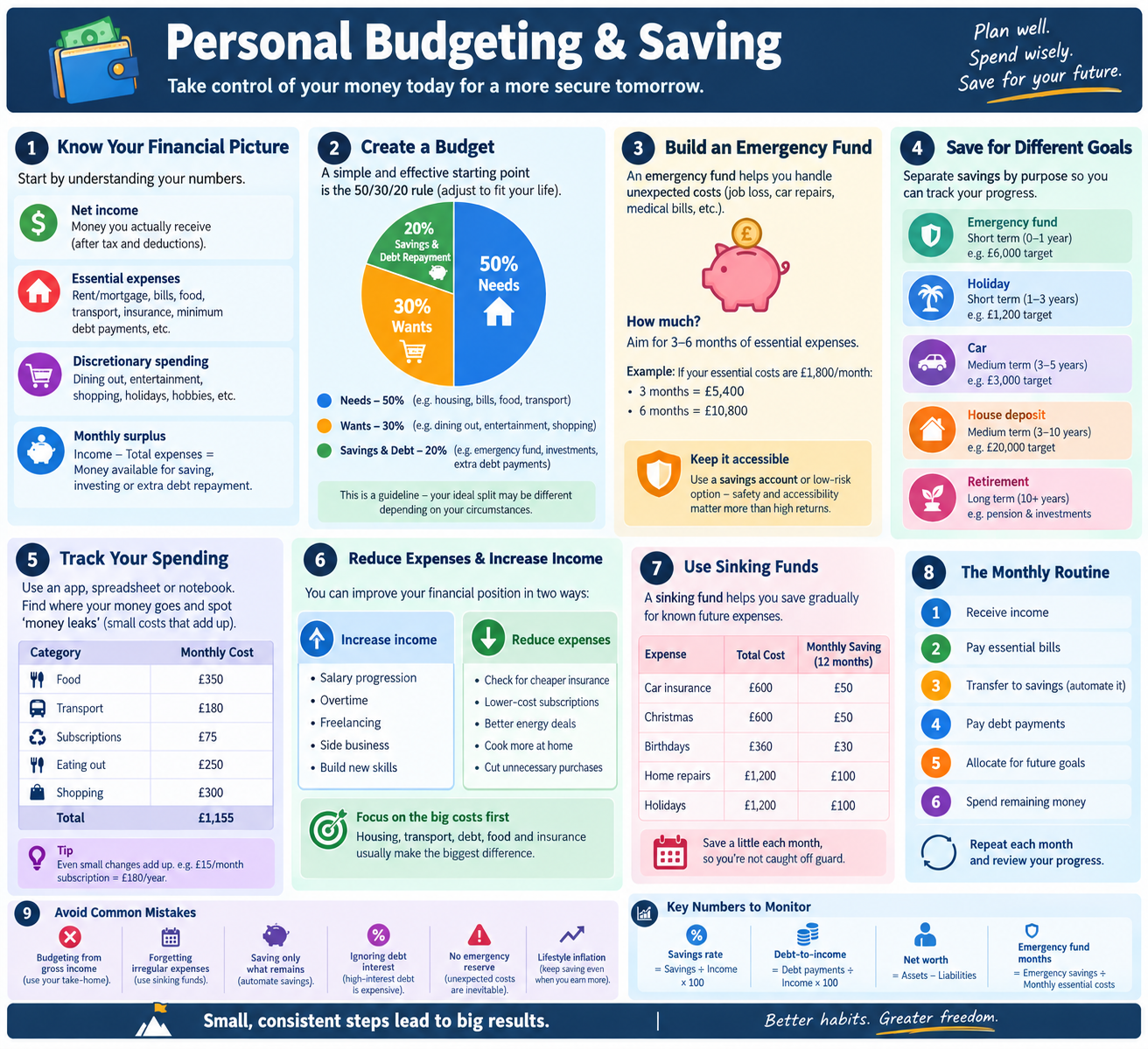

  • Personal Budgeting & Saving — Complete Guide

    Personal Budgeting & Saving — Complete Guide

    Personal Budgeting & Saving

    Personal budgeting is the process of deciding where your money should go before you spend it. Saving is the process of deliberately keeping part of your income for future needs and goals.

    The overall system is:

    Earn → Budget → Spend → Save → Protect → Invest

    1. Start with your financial picture

    Before making a budget, calculate four numbers:

    Monthly net income

    The money that actually reaches your account after tax and other deductions.

    Include:

    • Salary
    • Self-employment income
    • Benefits, where applicable
    • Regular freelance income
    • Other reliable income

    Don’t rely on uncertain income when planning essential expenses.

    Monthly essential expenses

    Examples:

    • Rent/mortgage
    • Council tax
    • Utilities
    • Food
    • Transport
    • Insurance
    • Minimum debt payments
    • Essential childcare

    Monthly discretionary spending

    Examples:

    • Restaurants
    • Entertainment
    • Shopping
    • Holidays
    • Hobbies
    • Subscriptions

    Monthly saving/debt reduction

    This is what you’re deliberately allocating toward your future.

    A basic calculation is:Monthly Surplus=Net Income−Total ExpensesMonthly\ Surplus = Net\ Income – Total\ Expenses

    If income is £3,000 and expenses are £2,400:£3,000−£2,400=£600£3,000-£2,400=£600

    You have £600 available for saving, investing, additional debt repayment, or other goals.

    Build a simple budget

    A useful starting framework is the 50/30/20 rule:

    • 50% → needs
    • 30% → wants
    • 20% → saving/debt repayment

    But treat this as a framework, not a law.

    Someone living in an expensive area might need considerably more than 50% for housing. Someone aggressively paying off debt might allocate much more than 20% toward financial goals.

    The best budget is one that reflects your actual circumstances.

    . Use three categories

    For simplicity, divide spending into:

    Needs

    Things you genuinely need.

    Wants

    Things that improve your lifestyle but aren’t essential.

    Future you

    Money allocated to:

    • Emergency savings
    • Debt repayment
    • Pension
    • Investments
    • Major future purchases

    This third category is important because saving shouldn’t be treated as merely “whatever happens to be left.”

    Pay yourself first.

    Automate saving

    One of the easiest ways to save consistently is automation.

    For example:

    Salary arrives → automatic transfer → savings account

    rather than:

    Salary arrives → spend → save whatever remains

    Suppose you receive £2,500 per month.

    You could automatically transfer £300 to savings shortly after payday.

    Over 12 months:£300×12=£3,600£300 \times 12 = £3,600

    That’s £3,600 saved without requiring a decision every month.

    Create an emergency fund

    An emergency fund is money specifically reserved for unexpected financial problems.

    Examples:

    • Losing your job
    • Major car repair
    • Emergency travel
    • Unexpected household expense
    • Essential replacement purchase

    The appropriate size depends on your circumstances.

    Consider:

    • Job stability
    • Dependants
    • Housing costs
    • Insurance
    • Health-related costs
    • Debt
    • Whether you’re self-employed

    . Keep emergency money accessible

    Emergency savings generally shouldn’t be placed somewhere where you could lose a large portion of the money when you need it.

    For money needed in the short term, people commonly consider savings accounts or other low-risk, accessible arrangements.

    The objective isn’t maximum investment return.

    It’s:

    Safety + accessibility + reasonable interest

    Separate savings by purpose

    Instead of having one giant savings balance, you can create different goals.

    For example:

    GoalTargetMonthly saving
    Emergency fund£6,000£300
    Holiday£1,200£100
    Car£3,000£150
    House deposit£20,000£250

    This makes your progress much easier to understand

    Use sinking funds

    A sinking fund is money gradually saved for a known future expense.

    Suppose you know you’ll need £600 for car insurance in 12 months.

    Instead of finding £600 suddenly:£600/12=£50£600/12=£50

    Save £50 each month.

    Other sinking funds might cover:

    • Christmas
    • Birthdays
    • Holidays
    • Car maintenance
    • Annual insurance
    • School expenses
    • Home repairs

    This prevents predictable expenses from becoming financial emergencies.

    . Track your spending

    You can’t manage what you don’t understand.

    For one month, record every expense.

    You might discover:

    Food: £350
    Transport: £180
    Subscriptions: £75
    Eating out: £250
    Shopping: £300

    The purpose isn’t to feel guilty about spending.

    It’s to identify where your money is actually going.

    Find your “money leaks”

    Small recurring expenses can add up.

    For example:

    £15 subscription × 12 = £180/year

    £40/month takeaway spending = £480/year

    £75/month impulse purchases = £900/year

    Individually these may seem insignificant. Collectively they can materially affect your savings rate.

    But don’t try to eliminate every enjoyable expense.

    A sustainable budget should leave room for enjoyment

  • What Is Personal Finance? A Complete Beginner’s Guide

    What Is Personal Finance? A Complete Beginner’s Guide

    Managing money is an important part of everyday life. Whether you are a student, employee, business owner, freelancer, or parent, the way you handle your money can affect your lifestyle, financial security, and future opportunities.

    Many people earn money every month but still struggle to save, pay bills, or achieve their financial goals. In many cases, the problem is not only how much money they earn but also how they plan, spend, save, and manage it.

    This is where personal finance becomes important.

    Personal finance helps individuals understand how to manage their income, control expenses, save for future needs, handle debt, and make informed financial decisions.

    In this beginner-friendly guide, you will learn what personal finance means, why it matters, its main components, and practical steps you can take to improve your financial habits.

    What Is Personal Finance?

    Personal finance is the process of managing your money to meet your current needs and future financial goals.

    It involves making decisions about how you earn, spend, save, borrow, invest, and protect your money.

    Personal finance applies to almost everyone, regardless of income level. Someone earning a small salary and someone earning a large salary both need to make financial decisions.

    For example, personal finance includes:

    • Deciding how much money to spend on food and housing.
    • Setting aside money for emergencies.
    • Paying bills and managing debt.
    • Saving for education, a home, or retirement.
    • Choosing appropriate financial products.
    • Planning for unexpected expenses.

    The main purpose of personal finance is to help you use your available resources thoughtfully and prepare for future financial needs.

    Why Is Personal Finance Important?

    Understanding personal finance can help you make better decisions about your money.

    Here are some important reasons to learn personal finance.

    1. It Helps You Control Your Spending

    Without a spending plan, it can be difficult to know where your money goes each month.

    A budget allows you to identify your essential expenses, understand your spending habits, and decide how much money you can reasonably use for nonessential purchases.

    For example, reviewing your monthly spending may reveal that several small subscriptions are taking up money you could use for savings.

    2. It Helps You Build Savings

    Savings can help you prepare for planned expenses and unexpected situations.

    You might save for school fees, household purchases, medical expenses, travel, or a future business.

    A consistent saving habit can make it easier to prepare for these expenses without relying entirely on borrowing.

    3. It Helps You Manage Debt

    Borrowing can sometimes help people meet important financial needs, but debt also comes with responsibilities.

    Personal finance helps you understand interest rates, repayment schedules, borrowing costs, and the consequences of missed payments.

    With this knowledge, you can evaluate borrowing decisions and develop a realistic repayment plan.

    4. It Helps You Prepare for Emergencies

    Unexpected events can create financial pressure.

    An emergency fund can provide money for certain unplanned expenses, such as urgent home repairs, temporary income loss, or essential travel.

    The amount needed depends on your personal circumstances, household expenses, income stability, and responsibilities.

    5. It Helps You Plan for the Future

    Personal finance encourages you to think beyond your next paycheck.

    You can set goals for education, housing, retirement, starting a business, or supporting your family.

    Planning ahead gives you a clearer idea of how much money you may need and what steps could help you work toward those goals.

    The 7 Main Components of Personal Finance

    Personal finance includes several connected areas. Understanding each one can help you build a practical money management system.

    BCBA Private Practice Salary Explained: What You’ll Actually Take Home

    1. Income

    Income is the money you receive from work, business activities, investments, or other sources.

    Examples include salaries, wages, freelance payments, business profits, and rental income.

    Understanding your income helps you determine how much money is available for spending, saving, and other financial priorities.

    List Of Monthly Budget Expenses

    2. Budgeting

    Budgeting is the process of planning how you will use your income.

    A budget helps you organize your money into categories such as housing, food, transportation, savings, and entertainment.

    It also helps you compare your planned spending with your actual spending.

    3. Saving

    Saving means keeping some of your money for future use instead of spending it immediately.

    Savings can support emergencies, short-term goals, and planned purchases.

    You can save regularly by setting aside a manageable amount whenever you receive income.

    Las deudas prescriben en Costa Rica, conozca las condiciones que deben darse para que esto ocurra  | El Financiero

    4. Debt Management

    Debt management involves understanding and repaying money you owe.

    This may include credit cards, personal loans, student loans, or other borrowing arrangements.

    Knowing your balances, interest rates, and payment dates can help you organize repayments and understand the total cost of borrowing.

    Winning With AI Tools In Private Credit Investment Research | Brightwave

    5. Investing

    Investing involves putting money into assets with the aim of earning returns or achieving financial growth over time.

    Examples include stocks, bonds, mutual funds, and certain property investments.

    Investments involve different levels of risk, and returns are not guaranteed. Understanding those risks is an important part of making investment decisions.

    6. Insurance and Financial Protection

    Insurance can help protect you against certain financial losses covered by a policy.

    Depending on your needs and location, this may include health, life, vehicle, home, or business insurance.

    Understanding premiums, exclusions, deductibles, and coverage limits is important before purchasing a policy.

    Dave Ramsey Tells 57-Year-Old Investing $2,800 Monthly to Cut Retirement Contributions in Half - AOL

    7. Retirement and Long-Term Planning

    Retirement planning involves preparing financially for the time when you may no longer receive regular employment income.

    It may involve savings, retirement accounts, pensions, and long-term investments.

    Starting with a realistic plan can help you understand the resources you may need in the future.

    How to Manage Your Personal Finances Step by Step

    You do not need to be a financial expert to begin managing your money. Start with simple actions and improve your approach as your circumstances change.

    Your beginner’s money plan

    Use this checklist to organize your first steps.0 of 7 steps completedCalculate your total monthly take-home income.List your essential and nonessential expenses.Create a realistic monthly budget.Set a savings goal that fits your circumstances.List your debts, interest rates, and due dates.Review your financial goals and protection needs.Check your spending and savings progress every month.

    Step 1: Calculate Your Income

    Begin by identifying how much money you receive during a typical month.

    If you earn a salary, use the amount you actually receive after deductions. If you work for yourself, estimate your income carefully and account for business expenses and taxes where applicable.

    If your income changes from month to month, reviewing several months of income can help you create a more realistic plan.

    Step 2: Track Your Expenses

    Write down the money you spend.

    You can use a notebook, spreadsheet, budgeting app, or simple expense tracker.

    Divide your spending into categories such as:

    • Housing and utilities.
    • Food and groceries.
    • Transportation.
    • Education and childcare.
    • Debt payments.
    • Savings.
    • Entertainment and personal purchases.

    Tracking expenses can help you identify spending patterns and areas where adjustments may be possible.

    Step 3: Create a Monthly Budget

    A budget is a plan for how you will allocate your money.

    One popular budgeting method is the 50/30/20 rule.

    Under this approach, you allocate your after-tax income as follows:

    CategorySuggested share
    Needs50%
    Wants30%
    Savings and debt repayment20%

    These percentages are a guideline, not a strict requirement. Housing costs, family responsibilities, debt, and income levels may make a different allocation more realistic.

    Step 4: Set Financial Goals

    Financial goals give your money a purpose.

    Instead of simply saying, “I want to save more,” create a specific target.

    Examples include:

    • Save a particular amount for emergency expenses.
    • Pay off a specific debt.
    • Save for a course or professional qualification.
    • Build funds for a future business.
    • Prepare for retirement.

    For each goal, identify the amount needed, your target date, and a manageable contribution schedule.

    Step 5: Build an Emergency Fund

    An emergency fund is money set aside for unexpected expenses or financial disruptions.

    Start with an amount that is achievable for your situation. As your savings grow, you can work toward a larger reserve based on your essential monthly expenses and income stability.

    Keep emergency savings accessible, while considering the safety, fees, and withdrawal conditions of the account you use.

    Step 6: Understand Your Debt

    Make a list of the money you owe.

    Include:

    • The lender or creditor.
    • Your outstanding balance.
    • The interest rate.
    • The minimum payment.
    • The payment due date.

    This information helps you understand your obligations and decide how to organize your repayments.

    Avoid taking on new borrowing without considering the full repayment cost and whether the payments fit your budget.

    Step 7: Review Your Finances Regularly

    Your financial situation can change because of new expenses, income changes, family needs, or personal goals.

    Set aside time each month to review your budget, savings, debts, and progress.

    Adjust your plan when necessary instead of assuming that the same budget will work forever.

    A Simple Personal Finance Example

    Let’s look at a fictional example of someone who wants to organize their monthly income.

    Suppose a person receives ₦300,000 in monthly take-home income.

    They decide to use a version of the 50/30/20 budgeting method as a starting point.

    EXAMPLE MONTHLY BUDGET

    ₦300,000

    Illustrative take-home income

    Needs

    Savings and debt

    Wants

    Needs (50%)₦150,000
    Wants (30%)₦90,000
    Savings and debt (20%)₦60,000
    Total₦300,000

    In this example, the person plans to allocate ₦150,000 to essential needs, ₦90,000 to wants, and ₦60,000 to savings and debt repayment.

    The example is for educational purposes. Actual living costs and financial obligations may require a different allocation.

    Personal Finance Mistakes to Avoid

    Learning what not to do is also an important part of managing money.

    1. Spending More Than You Earn

    Regularly spending more than your income can lead to debt and financial stress.

    Review your expenses and adjust your budget when spending consistently exceeds available income.

    2. Not Having a Budget

    Without a budget, it may be difficult to understand where your money goes.

    A simple written plan can help you organize expenses and financial priorities.

    3. Ignoring Small Expenses

    Small purchases may seem insignificant individually, but recurring expenses can add up.

    Review your spending periodically to determine whether those purchases fit your priorities.

    4. Depending Too Much on Borrowing

    Borrowing for everyday expenses can become difficult to manage when repayment obligations accumulate.

    Before borrowing, consider interest, fees, repayment dates, and what would happen if your income changed.

    5. Investing Without Understanding the Risks

    Investments can lose value, and some financial offers may be misleading or fraudulent.

    Before investing, learn how the product works, what fees apply, how you can access your money, and what losses are possible.

    Be cautious of anyone promising guaranteed high returns with little or no risk.

    6. Delaying Financial Planning

    Putting off every financial goal until the future can make preparation more difficult.

    Even small steps, such as tracking expenses or setting aside a manageable amount, can help you begin.

    Personal Finance for Different Stages of Life

    Your financial priorities may change as you move through different stages of life.

    University Malaya Cost of Living 2026: Rent, Food & Student Budget Guide | Westay Coliving — WeStay Coliving

    Students

    Focus on understanding expenses, managing available funds, avoiding unnecessary borrowing, and preparing for education-related costs.

    CPFB | Map your life goals with PLAN with CPF

    Young Professionals

    Build budgeting habits, establish savings, understand workplace benefits, and begin setting longer-term goals.

    More people are embracing viral ‘no-buy challenges’ to combat overconsumption | The Independent

    Families

    Plan for housing, education, childcare, insurance, household expenses, and shared financial responsibilities.

    25+ Eye-Opening Facts About Owning a Business in 2026

    Business Owners and Freelancers

    Track income fluctuations, separate personal and business finances, plan for taxes, and maintain adequate cash reserves.

    Should I Buy Into a Practice If My Main Goal Is Early Ret...

    People Preparing for Retirement

    Review expected retirement income, expenses, savings, pensions, healthcare needs, and plans for accessing retirement funds.

    How Technology Can Help You Manage Personal Finance

    Technology can make it easier to organize your finances, monitor spending, and track progress toward goals.

    Some useful tools include:

    • Budgeting spreadsheets for planning monthly expenses.
    • Banking apps for checking transactions and balances.
    • Savings calculators for estimating future savings.
    • Expense trackers for recording purchases.
    • Debt repayment calculators for comparing payment schedules.

    When using financial apps, check their fees, privacy policies, security features, and the permissions they request.

    Avoid sharing passwords, PINs, or one-time verification codes with anyone claiming to provide financial assistance.

    Frequently Asked Questions About Personal Finance

    1. What is personal finance in simple words?

    Personal finance means managing your own money, including what you earn, spend, save, borrow, and invest.

    2. Why is personal finance important?

    It helps you organize your income, manage expenses, prepare for unexpected costs, understand debt, and work toward financial goals.

    3. How can I start managing my money?

    Start by calculating your income, tracking expenses, creating a budget, setting a savings goal, and reviewing your progress regularly.

    4. What are the main areas of personal finance?

    The main areas include income, budgeting, saving, debt management, investing, insurance, and long-term financial planning.

    5. How much money should I save every month?

    There is no single amount that works for everyone. Your savings target depends on your income, essential expenses, debts, responsibilities, and goals. Start with an amount you can maintain and adjust as your circumstances change.

    6. Can I manage personal finances with a low income?

    Yes. You can begin by understanding your income and expenses, prioritizing essential needs, and making a realistic plan. When income is insufficient to cover necessities, focus on available assistance and practical ways to address the shortfall rather than unrealistic savings targets.

    7. What is the difference between saving and investing?

    Saving generally means setting money aside for future use, often with an emphasis on accessibility and preserving the amount saved. Investing means purchasing assets in the hope of earning returns, while accepting the possibility of losing money.

    8. What is a personal budget?

    A personal budget is a plan that shows how you intend to use your income for expenses, savings, debt repayments, and other financial priorities.

    9. What is an emergency fund?

    An emergency fund is money reserved for unexpected expenses or financial disruptions, such as urgent repairs or temporary loss of income.

    10. When should I start learning personal finance?

    You can start at any age. Learning basic money management skills early can help you develop habits that remain useful throughout life.

    Conclusion

    Personal finance is an essential life skill that helps you understand and manage your money.

    By learning how to budget, save, manage debt, invest carefully, and prepare for future needs, you can make more informed financial decisions.

    You do not have to change everything at once. Begin with simple steps, such as tracking your expenses, setting a realistic financial goal, and reviewing your budget each month.

    Over time, these habits can help you build a clearer financial plan that reflects your needs, responsibilities, and goals.

    Remember: Personal finance is not about becoming wealthy overnight. It is about understanding your money and making thoughtful decisions with the resources available to you.

    Disclaimer: This article is for educational and informational purposes only. It does not constitute personalized financial, investment, tax, or legal advice. Financial products, regulations, and tax rules vary by country and individual circumstances. Consider consulting a qualified professional before making significant financial decisions.

    Before you publish on WordPress

    Add your website’s featured image.Set the SEO title, meta description, and URL slug.Add relevant internal links to other articles on your blog as you publish them.Check spelling, formatting, and mobile readability.Preview the article and publish when ready.

  • Hello world!

    Welcome to WordPress. This is your first post. Edit or delete it, then start writing!